The cartoon character running off the edge of the cliff makes a useful metaphor for the psychology of overvalued markets. As long as Wile E. Coyote doesn’t realize there is no ground beneath his feet, he can keep running in midair. When he looks down, he plummets. Although the world of physical matter doesn’t behave this way, financial markets sometimes do. And it may be a helpful lens through which to view the situation now confronting China.
For a year and a half, Chinese authorities have been trying to reduce property prices, leverage, and the economy’s dependence on the real estate industry. As defaults and distress spread, from China Evergrande Group to Kaisa Group Holdings Ltd. and others, the first signs of a shift toward policy easing emerged last year. Officials injected money into the economy by reducing the amount lenders have to keep in reserve at the central bank, sought to encourage financially stronger developers to take over embattled rivals, and even trimmed interest rates. The question is whether authorities are still in command. Having been pushed off the cliff, are China’s property investors, like Wile E. Coyote, just starting to look down?
In effect, the ruling Communist Party is attempting the challenging task of deflating a bubble gently. Policymakers in most countries shy away from directly targeting asset prices. For one thing, there’s no universally accepted definition of bubbles, which tend to be diagnosed only after they burst. Probably no country has ever tried to deliberately scale down a sector that was both so overvalued and so critical to economic growth. Real estate and related industries account for more than a quarter of China’s gross domestic product by some estimates. That makes this a bold, and risky, experiment.
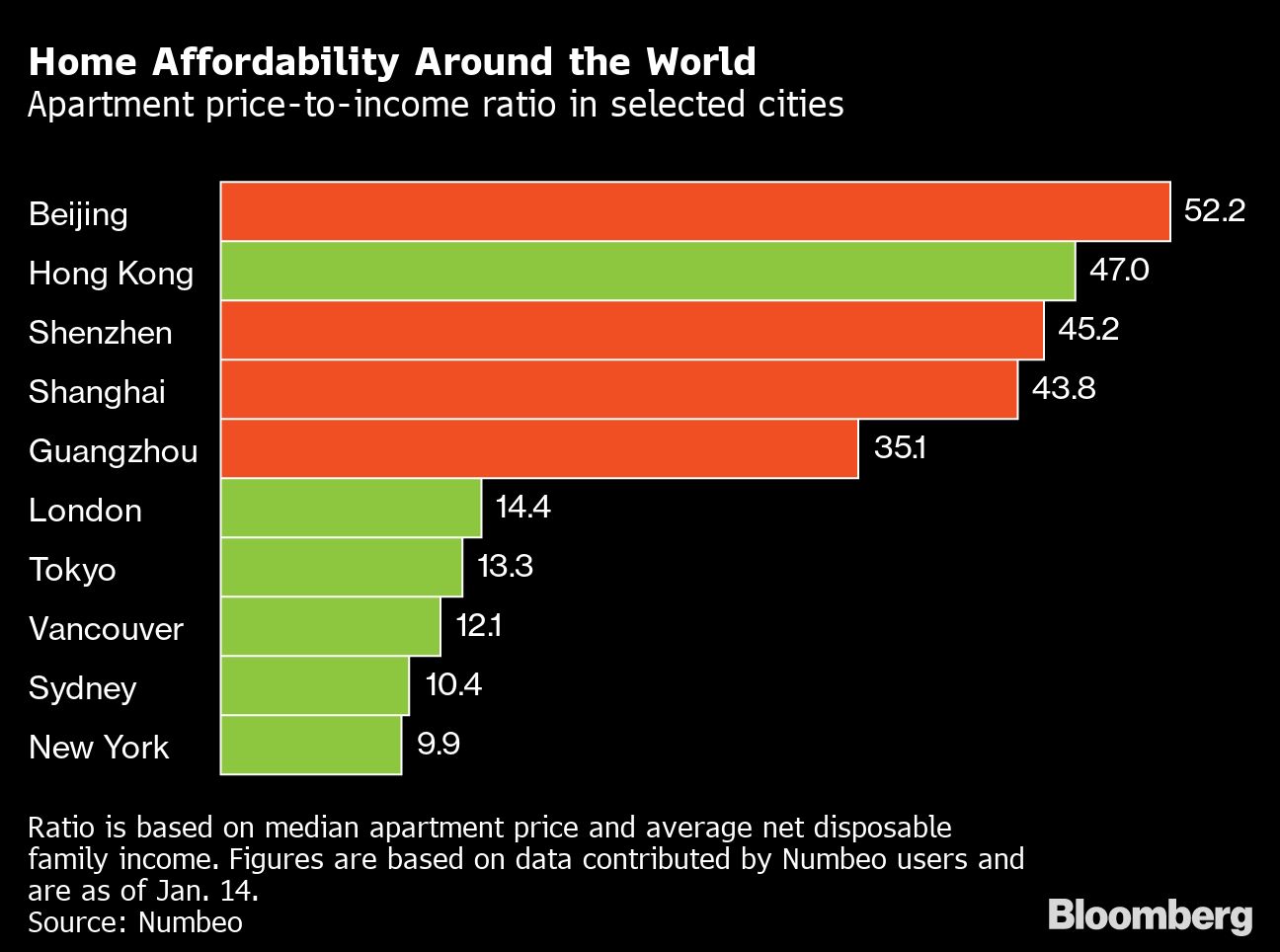
By any standards, China’s property bubble looks epic. Home prices in major cities such as Beijing, Shanghai, and Shenzhen are more than 30 times average annual incomes. That compares with ratios closer to 10 in leading global centers such as London and New York, where valuations already look stretched after more than a decade of near-zero interest rates. Rental yields in China are tiny, at less than 2%. Overbuilding has been endemic: The country had about 65 million empty units as of 2017. The property industry, meanwhile, sucks up huge amounts of debt capital: about 27% of loans in the local currency as of September (down from a 2019 peak of 29%), according to People’s Bank of China data. Other estimates suggest the true share of property-related loans may be much higher. More than a decade ago, U.S. hedge fund manager Jim Chanos said China was on a “ treadmill to hell” because of the country’s dependence on real estate for growth. That reliance hasn’t notably shifted.
The Chinese government has appeared to share some of these concerns. After years of warning of unbalanced and unsustainable development and periodic stop-start campaigns to cool the property market, authorities in mid-2020 adopted a policy known as the “ three red lines” to restrict the leverage of developers. This time, the government showed a determination to stick with the program, even at the cost of some financial turmoil and reduced economic growth. In August 2021, economists at Nomura Holdings Inc. described the curbs as a potential “Volcker Moment,” comparing them to the policy followed in the early 1980s by Federal Reserve Chairman Paul Volcker, who triggered a deep recession when he raised U.S. interest rates to 20% to squeeze inflation out of the system.
Like the U.S. under Volcker, China has taken some pain—more than some people (including this commentator) expected. Evergrande, the world’s most indebted developer, was declared in default in December. Contagion spread to shares and bonds of other stressed companies including Kaisa, Shimao Group Holdings Ltd., and Fantasia Holdings Group. Residential property sales plunged, and new-home prices declined for a third straight month in November, falling by the greatest percentage since 2015 (albeit just -0.3%). Economists cut their growth estimates, and calls for more stimulus mounted.
The subsequent signs of policy softening, including a Jan. 17 cut in the central bank’s key interest rate, suggest the pain threshold may have been reached. The dilemma for the government—and for investors in Chinese assets—is whether this mechanism, once set in motion, can be controlled or finessed. In a speculative market, “it is almost impossible to stabilize prices,” as Michael Pettis, a professor of finance at Peking University, observed last year in considering the proposed introduction of a property tax. “Once prices stop going up, they must go down.”

The fundamentals underpinning the country’s property valuations look questionable, to put it mildly. Granted, there are some structural reasons housing in China might be valued more richly than overseas. Capital controls restrict the extent to which domestic investors can buy assets internationally, and options are limited at home as well—poor corporate governance, volatility, and regulatory flip-flops can make stocks an unpalatable choice. Against this backdrop, bricks-and-mortar looks like a relatively safe bet. What sustains property more than anything else is the belief that the industry’s growth and importance is supported by official policy, which has ensured decades of steadily rising prices. Take that away, and there may be nothing holding up Chinese real estate but air.
Yet this is exactly what authorities have done. To cut the umbilical link between debt, construction activity, speculation, and economic growth, officials have gone out of their way to signal that the long property boom is over, repeating President Xi Jinping’s mantra that “houses are for living in, not for speculation.” In these circumstances, it’s fair to ask why anyone who doesn’t need to would buy real estate that, by any objective standard, is already expensive and oversupplied.
It’s a dangerous dynamic. If buyers lose confidence and home prices fall significantly, that would erode the principal store of Chinese households’ wealth, sending multiplier effects cascading through the economy, stock market, global commodity prices, and world demand. The argument for optimism lies in China’s economic record. The Communist Party has overseen four decades of often spectacular growth that has made China the world’s second-largest economy, eradicated extreme poverty, and brought the country to the verge of high-income status. Through that time, its technocratic leaders have managed wrenching transitions and kept expansion going in the face of imbalances and dislocations. Surely they can be trusted to handle the fallout from this latest adjustment?
Perhaps. In fact, China’s interventions in markets have sometimes been clumsy and ineffective. In 2015, official boosterism helped inflate a stock market bubble, which then burst. Authorities switched to organizing a rescue, which floundered. Attempts to micromanage market behavior have typically led to overshooting in one direction or another. Arguably, the property campaign is itself the admission of a failure—evidence of the government’s inability to restrain prices and activity over repeated economic cycles. In the end, the boom got so big that authorities decided they had no choice but to act, even at the cost of economic growth, the party’s Holy Grail for the past three decades.
The real estate push forms part of a wider initiative under Xi that includes a more muscular approach to the private economy and markets and a reassertion of the primary role of the state sector. Under the banner of creating “ common prosperity,” Xi has also targeted monopolistic behavior by giant technology corporations such as Alibaba Group Holding Ltd. and Tencent Holdings Ltd., wiping hundreds of billions of dollars off the value of their overseas-traded shares in the past year.
Whether this is a necessary rebalancing of an excessively unequal society that will lay the foundation for the next phase of China’s growth or a quixotic return to Marxist roots that will undermine the entrepreneurial energy and animal spirits that have been so essential to the country’s economic rise, it’s too early to say. That’s a question for the long run, and as the British economist John Maynard Keynes observed, in the long run we’re all dead. Investors have more immediate concerns.
For stocks, at least, there are reasons for near-term optimism. It’s notable that in the closing months of 2021, even as property turmoil was spreading, several global investment banks upgraded their forecasts for Chinese equities. As of mid-December, the MSCI China Index had underperformed global peers by 37 percentage points—the biggest gap since 1998. Signs of policy loosening led banks from Goldman Sachs Group Inc. to UBS Group AG to see a turning point. JPMorgan Chase & Co.’s Marko Kolanovic predicted the MSCI China will surge almost 40% in 2022.
China has always been a policy-driven market, and credit creation is the policy indicator that trumps all others. Gavekal Research Ltd.’s Thomas Gatley says private-sector credit growth offers a simple and robust decision rule for Chinese asset allocation: When the measure is accelerating on a three-month moving average basis, buy equities; when it’s decelerating, buy government bonds. Following this rule using the MSCI China would have yielded an annualized return of 14.8% in the 10 years to October 2021, he wrote, compared with the index’s total return of 8.7%.
That’s the silver lining in the real estate shakeout. If China does continue to ease monetary policy through 2022, investors will have the weakness in property to thank. As cartoon watchers know, Wile E. Coyote always gets a second chance. Even after hitting the ground from a great height, he’s soon up and chasing Road Runner again.
Bloomberg News provided this article. For more articles like this please visit
bloomberg.com.
Read more articles by Matthew Brooker