Johan Norberg’s History of the World in 7 Golden Ages , and a Clarion Call for Today
Membership required
Membership is now required to use this feature. To learn more:
View Membership BenefitsThe views presented here do not necessarily represent those of Advisor Perspectives.
What can investors learn from ancient history?
How about Muslim history, or the Song Dynasty of China (960 AD-1279 AD), or the Italian Renaissance and the Dutch Republic?
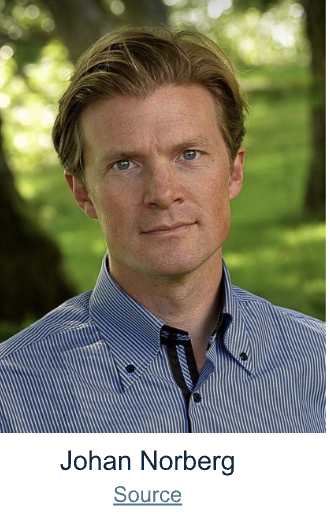
In his new book, “Peak Human,”1 Johan Norberg, “a superstar of the global freedom movement”2 and author of the bestselling books “Progress” and “The Capitalist Manifesto” (both reviewed by me in Advisor Perspectives),3 encourages us to learn about past golden ages and what made them golden. By understanding these culturally and economically special times in human history, and their rise and decline, we can shape our own future in better ways. And, because we have technologies (most notably modern medicine) they did not have, we can live even more productive and enjoyable lives than our successful forbears did.
That happy outcome assumes we don’t destroy our own culture. We could, and in a change of mood from his previous work, the relentlessly optimistic Norberg sees the warning lights flashing. He wrote “Peak Human” partly in hope of preventing such destruction.
After reviewing in some detail the most notable golden ages of ancient, medieval, and early modern times, Norberg homes in on our own golden age — that of the Anglosphere over the last two centuries. Fully one-third of the book is on that topic.
A flourishing society and economy are a sine qua non for successful investing. If we identify the best and worst features of “peak human” societies, emulate the best, and avoid the worst, we can increase our chances of continuing to enjoy the high long-term investment returns that have characterized Western civilization over the last 200 years. In Norberg’s estimation, the best feature of all these cultures was openness to new ideas and foreign peoples. The worst is slavery, which the Anglosphere began to eradicate in the early 1800s, and which now is viewed with revulsion almost everywhere.
If we do the opposite, we might end up in the same place as Umayyad Caliphate and the Song Dynasty — a curiosity for historians to study. I don’t think we will fail in that way, because instant and near-universal communication make the benefits of our modern civilization obvious to anyone who is paying attention. The recipe for modernity, consisting of liberal capitalism, property rights, the rule of law, and democracy — plus Norberg’s secret sauce, openness to outside influences — can also easily be observed and copied. Yet, sadly, each of these ingredients is fiercely opposed by some. We should not think our civilization is immune to the ills that befell those of our predecessors.
Outline of This Review
“Peak Human” covers seven golden ages: Greece, Rome, the Abbasid Caliphate, China’s Song Dynasty, the Italian Renaissance, the Dutch Republic, and the “extended Anglosphere” of today. (This last golden age emerged in northwestern Europe among the English and Dutch-speaking peoples in the 18th century but grew to encompass Western civilization itself.) Most readers are familiar (at least in outline form) with Greece, Rome, and the Renaissance, so I’ll first focus on the least familiar of these ages, the Islamic ascendancy of the eighth and ninth centuries under the Abbasids and the Song Dynasty in medieval China. Then I’ll skip ahead to the Enlightenment, which launched the golden age of the Anglosphere and what we call modernity — and, following Norberg, identify perils that we face and suggest some hopeful paths forward.
Why did Norberg pick these particular examples of human flourishing? “Because,” he writes, “each of them exemplifies ... a period with a large number of innovations that revolutionize many fields and sectors in a short period of time.” Whether you love or hate the world of today, that’s an accurate description of it. He continues,
A golden age is associated with a culture of optimism, which encourages people to explore new knowledge, experiment with new methods and technologies, and exchange the results with others... Its result is a high average standard of living, which is usually the envy of others, often also of their heirs.
We don’t have to look very far back in our own past to find a culture of optimism. Today’s zeitgeist may feel gloomier, but the reality is actually quite positive; the perception that the world is coming to an end can rapidly change.4 Let’s make sure that our commitment to openness and innovation does not wane such that it’s our heirs who are envious of, and nostalgic for, the golden age of the Anglosphere.
The Abbasid Caliphate: Islam Leads the World
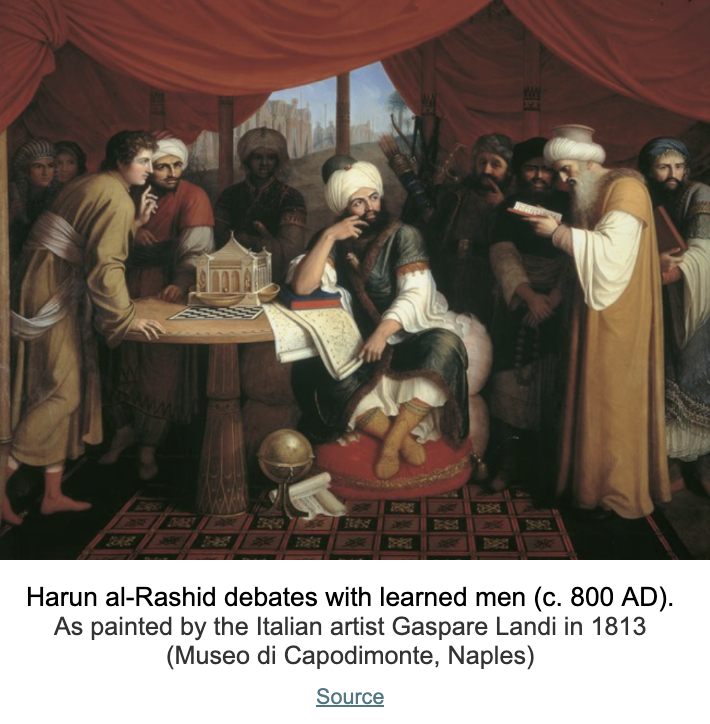
The How and Why Wonder Book version of history says that, after the fall of Rome, humanity experienced a thousand years of darkness. The wisdom of the Greeks and Romans was almost lost, nothing new was invented for centuries, and the moral universe of Game of Thrones ruled.
This isn’t even true of Europe — the Dark Ages weren’t entirely dark, and the High Middle Ages (after 1100) were vibrant in many ways — but, according to the incomparable French historian Fernand Braudel, “For four or five centuries, Islam was the most brilliant civilization.”5
The accomplishments of medieval Islam would fill an encyclopedia. Norberg starts with the first (imaginary) volume, the letter “A”:
We don’t have to go further than the letter A to observe our intellectual debt to the Arab world: Arabic numerals, algebra, algorithm [so called after the 9th century mathematician Al-Khwarizmi], arithmetic, average. Or, for that matter, Averröes and Avicenna, two thinkers who had such an influence on the medieval Christian world that they were given these Latinized names...
...to say nothing of astronomy, where the letter A gives us Aldebaran, Altair, and dozens of other names of stars that are still used today. Avicenna (Ibn Sina) was considered the father of early modern medicine: “Rejecting the idea that diseases and disorders were the actions of gods or demons,” Norberg writes, “he insisted that they had natural causes.” (Some of today’s quacks don’t seem to have absorbed this 1300-year-old wisdom.)
How did Muslim scientists and artists accomplish all this, and why did it come to an end? Norberg attributes the golden age to a startling openness to foreign influences. Spanning one-quarter of the globe from Spain to India, the Abbasid caliphate crossed paths with “Christians, Jews, Zoroastrians, and pagans” and traded with them like madmen:
[Muhammad’s] followers...knitted almost the..,[whole] known world into a vast emporium in which African gold, ivory, and ostrich feathers could be exchanged for Scandinavian furs, Baltic amber, Chinese silks, Indian pepper, and Persian metal crafts,
writes William Bernstein in “A Splendid Exchange,” quoted by Norberg.6
The medieval Muslim economy was thus market-based. Looked down upon in Christianity until modern times, merchants (Muhammad was one) held an exalted position in Abbasid society. One of the most beloved stories that survived from that time and place is that of Sinbad the Sailor, a merchant whose wild adventures began when he left Baghdad in search of goods to trade. A millennium before the modern economist Deirdre McCloskey attributed the emergence of free-market capitalism in the 1700s to “the newfound dignity and liberty of the bourgeoisie,”7 Abbasid society held the bourgeois in esteem; it was more than a theocracy.
And, as one might expect in a market economy, prosperity spread beyond the top layer of society. “In 892,” Norberg writes, “there were over a hundred bookshops in Baghdad, which would not have been possible if only the privileged bought books.” (Note that, until the printing press was invented in the 1450s, every book in the world was hand-copied.)
Finally, the Muslim golden age had some notion of human freedom. Slaves, who existed in every premodern civilization, had more rights than the chattel African bondsmen of the antebellum American South. Women, though not free in the modern sense, “were allowed to start businesses, sign contracts, and ... had inheritance rights,” noted Norberg.
If I’ve made life in the Abbasid caliphate sound like paradise on Earth, it’s because, like Norberg, I’ve emphasized the positive. It wasn’t anything like paradise. The odd mix of beauty and cruelty, brilliance and barbarism that has characterized every age and every people was spectacularly in evidence. For example, Jews and Christians lived as dhimmis, populations that faced limits on their activities and special obligations such as taxes not owed by Muslims. But compared to what came later in the Muslim world, those were good times.
The Muslim Counter-Enlightenment and the End of the Islamic Golden Age
What went wrong?
Almost everything, although not in a dramatic event like Sparta’s defeat of Athens in 404 BC or the sack of Rome in 410 AD. The Abbasid decline, in the 11th and 12th centuries, was more like the death of a thousand cuts: the rise of the cleric Abu Hamid al-Ghazali, who taught that “the state and the religion are twins,” and who denied the reality of science; neglect of the arts, architecture, and writing; conquest of much of the Islamic world by the Mongol army; and, in the economy, “a turn towards a feudalistic system” with diminished respect for merchants, traders, and thinkers.
This pattern would be repeated, with variations, as every golden age discussed by Norberg came to an end — except our own. However, Norberg sees similar early warning signs of decline in Western civilization now.
Norberg is not kind to the current version of Islam as manifested in the governments and popular passions of some predominantly Muslim countries. He contrasts these with the Islamic golden age, acerbically describing the latter as “[an] age when Muslim rulers did not torture and kill dissenters and infidels, but learned from them ... ” Enough said.
The Song Dynasty: China Flourishes as the West Stagnates
At least the Muslim golden age took place in close enough proximity to the West that it was known to Europeans. The commentaries of Averroes (Ibn Rushd) on Aristotle were universally read by Western scholars, and Avicenna influenced European medical and scientific thought. The brilliance of China’s Song Dynasty had no such effect, because China and Europe barely communicated until the age of Marco Polo, who reached China in the late 1200s, just as the Song Dynasty was expiring.
If modern Americans and Europeans have a mental image of medieval China, it is of a rigid bureaucracy that invented the civil service exam and supported Monty Python-like occupations such as “Strewer of Rose Petals in the Back Garden.”8 As Norberg tells us in detail, there was much more to China during the Song Dynasty (960-1279 AD) than that.
Like ninth-century Baghdad, twelfth-century Kaifeng9 as portrayed in the painting shown below was
...a dizzyingly free market...[with] wine, grain, cookware, medicine, furniture, fabrics and musical instruments. There are doctors, barbers, monks, millers, metalworkers and carpenters. There are multi-storey restaurants...and even food delivery drivers. There are actors, jugglers, servants, scholars, monks and fortune-tellers.
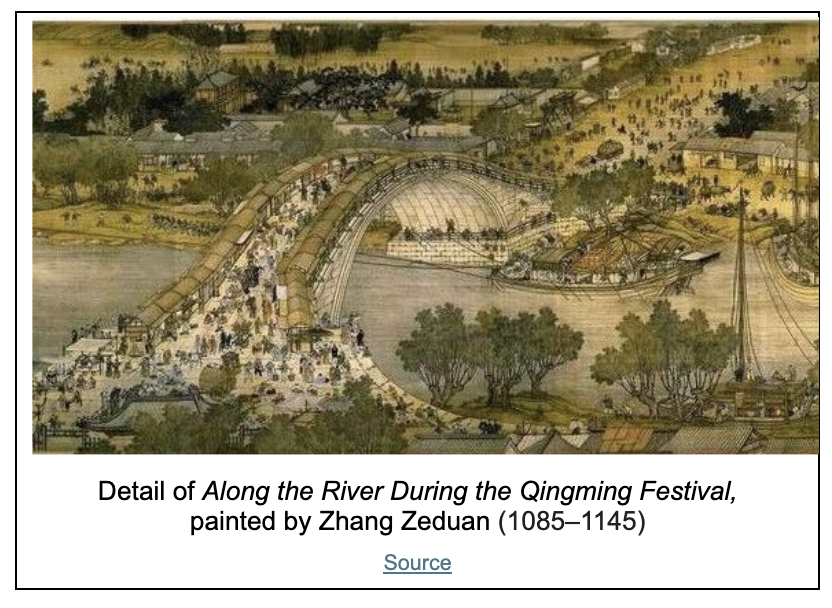
It sounds a little like the eighteenth-century London of our imagination. Adam Smith, who actually lived in eighteenth-century London, wrote admiringly of China’s past, and 250 years later Stephen Davies, a colleague of Norberg’s, said that “in the key areas of economy, government ... and intellectual life and scientific investigation Song China was as close to modernity as eighteenth-century Europe.”10 But, by Smith’s time, China had fallen into desperate poverty, and when Stephen Davies was born in the 1950s, it was no better.
Like Greece and Rome, Song China developed a version of economic freedom. After describing the many ways in which the people flouted and eventually overturned “stern regulations,” the historian Dieter Kuhn writes that, “Song society enjoyed a degree of early laissez-faire liberalism that distinguished it from contemporary societies.”11 Revealingly, Norberg adds, “this was not based on an elaborate plan from the top. It came from the citizens on the ground.”
A key feature of a free-market economy is property ownership by the common people:
The share of farmers who owned ... their own land ... was around 60-70 per cent... In the more commercial regions only 10-20 per cent of the rural population lacked land, which would have seemed unbelievable to contemporary Europeans...
Unfortunately McCloskey's bourgeois dignity did not flourish in Song China to the extent it did in some early commercial societies. Norberg writes that, “unlike in the Arab culture, merchants and markets were not highly esteemed.” Centuries earlier, a contemporary of Confucius (c. 551–479 BC) had grumbled that, “the best life was obviously that of a Confucian scholar, but ... becoming a merchant or artisan was [at least] better than becoming a beggar or thief.”12 This view persisted into the Song era and beyond.
Such an attitude explains a lot about Song China’s failure to kick off an industrial revolution six centuries early. Some societies that did honor inventors and entrepreneurs also declined and fell, however, so we can’t conclude too much from this bit of antediluvian snark.
How the Chinese Golden Age Ended
Song China could have sparked a uniquely Chinese, rather than European, entry into modernity and saved the Chinese people hundreds of years of crushing poverty. In 1776, Adam Smith wrote that, “The poverty of the lower ranks of people in China [today] far surpasses that of the most beggarly nations in Europe,”13 a comment that the usually genteel Smith follows with a graphic description too unseemly to print here.
Emblematic of the decline was the destruction of Zheng He’s Treasure Fleet in 1433, which had expanded trade as far afield as Arabia and East Africa.14 If Zheng had been allowed to continue exploring, China might have encountered America some decades before Columbus, the Americas could have been colonized from Asia rather than Europe, and China would have remained the dominant country in the world.15
Norberg’s Lessons From Chinese History – and From the Other Golden Ages
Although I didn’t go into as much detail on Song China as I did with the Abbasid caliphate, we can spot Norberg’s recurrent themes in both stories: markets — both the literal marketplace and the market for ideas, labor, and capital — bring freedom and prosperity. They democratize invention and creativity, which would otherwise remain in the hands of the few. Progress bubbles up from the individual and small groups, not down from the ruler.16 Cities are the fount of new ideas and create wealth. Large populations are more innovative than small ones.
And golden ages are always subject to decay — most often from within — and then demise.
Triumph of the Anglosphere
The best and most likely to endure of the seven golden ages, in Norberg’s estimation, is the Anglosphere or English-speaking world from the late 1700s to today — “if we can keep it,” he warns, echoing Benjamin Franklin’s comment about the United States being a republic.
Why the best? I’ll summarize the obvious — unprecedented prosperity enjoyed widely — with this fact according to Norberg:
If we measure...prosperity with [real] GDP per capita ... then half of the level of wealth that mankind has attained was created during the ten thousand years until 1990. The other half has been created since 1990...
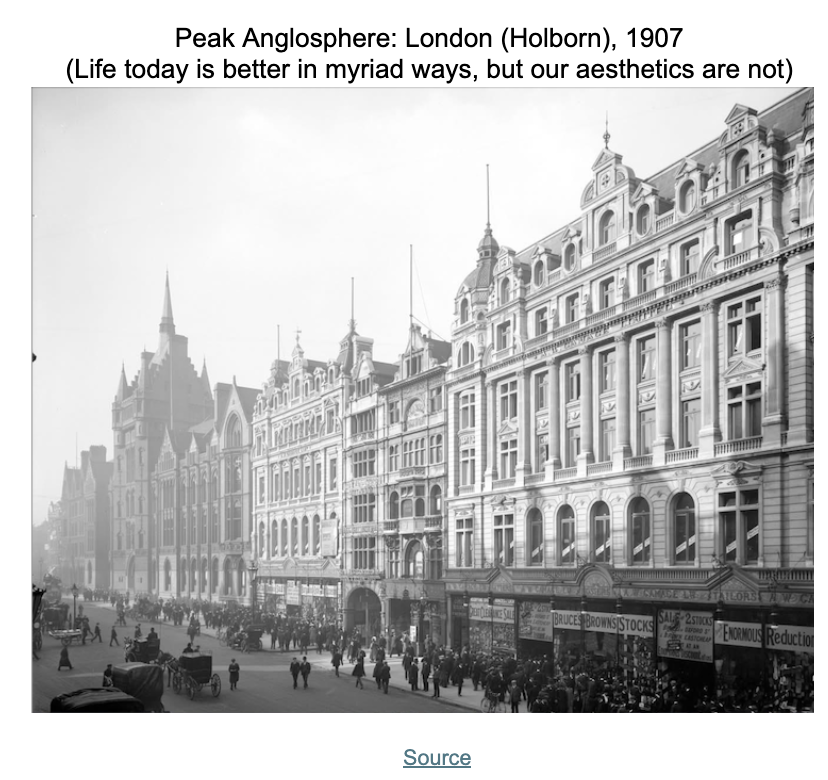
But the most important achievement of the Anglosphere has been to spread its values and attainment outward to envelop most of the world. Looking at poverty instead of wealth, global extreme poverty declined from 38% to 9%.17 To allow that statistic to return to anywhere near its prior level would be catastrophic.
Moving on from material well-being, let’s focus on morals. Every civilization in history has enslaved other humans, including the Anglosphere until it was abolished in England in 1772, the British Empire in 1833, and the United States in 1863. Norberg argues that this stain on our past, the horrors of which he recounts in some detail, must be balanced against the fact that the Anglosphere spent much blood and treasure getting rid of it when nobody else did. Before our own golden age, slavery was accepted almost universally as a fact of nature; during that age, it became a necessary evil, then an abhorrent one that is practiced only in the most deviant cases. Over time, the majority of the world came to align with the eventual Anglo-American point of view on the matter.
“Hypocrisy is the compliment vice pays to virtue,” Norberg concluded, paraphrasing La Rochefoucauld and capturing the idea that “if the dominant culture recognizes certain virtues, this can at times rein in its darkest vices.” Thus did the worst practices of British colonialism fade over time and then disappear, though their long-term effects perniciously linger.
The “Extended” Anglosphere
“One could even say,” Norberg concluded,
that all rich and free countries of the world are now part of an extended Anglosphere... These countries might not be English-speaking...but they are all inheritors of Anglo-American ideals... If the United States abandoned its commitment to [them], it is most likely that the remaining countries would work desperately to keep the rest of the order intact.
Norberg also remarked that, in the past, a hegemonic power has usually found the world’s other major powers ganging up on it. But not now. Of the world’s 30 largest economies, he noted, almost all are U.S. allies, 20 of them by treaty. Sixteen of them are outside Europe, our historic civilizational partner. Only two — Russia and China — try seriously to challenge us, and China (in my opinion) is more of an economic rival than an enemy. Despite some temporary quarrels with trading partners, the U.S. is in an enviable international position.
Are We Entering a New Dark Age?
In the title of this essay, I said that Norberg was issuing a clarion call for today. What is he worried about? Norberg warned us that, “we usually find our worst enemy in the mirror. As the historian D. C. Sumervell remarked, societies don’t die from natural causes, but from suicide or murder — and it is nearly always the former.”
Could the Triumph of the Extended Anglosphere end, by suicide or conquest, like all the other golden ages? If it does, it will indeed be followed by a very dark age. But what is the probability of such an outcome? What’s the current evidence that the end of our civilization is in the offing?
There are indeed signs of a darkening culture. That is not unusual, even if today’s problems seem worse than usual. But opposing the various forces of benightment is a very powerful advantage that no civilization before us has ever had: instant, almost free global communication. Seven billion people can now see, without much cost or effort, how the successful live and what they do to achieve their prosperity.
That recipe, established in the Anglosphere more than two centuries ago, and proving its value in many places and times thereafter, is adherence to the fundamental principles of the Enlightenment: free markets and free minds, supremacy of the individual, and, of course, property rights, the rule of law, and democracy. To these I’d add knowledge of the past and of other cultures, and preservation of what is best about the past as we move forward into the future.
If we adhere to these fundamental values, it will be almost impossible for Western civilization and its offshoots (which include most of the world, to varying degrees) to turn on itself and enter an Abbasid- or Song-like decline. Norberg wrote:
One difference with previous golden ages is that we now have more eggs in different baskets. Once upon a time, if Athens or Baghdad failed, it was game over. Now we have ... roughly fifty ... prosperous, open societies.
... and, I’d add, most of the others desperately want to be, even if the efforts of some of them are bumbling or even counterproductive.
This “neural network” of human beings is more durable and wide-ranging than any network that has ever existed before. It binds together people who in prior eras had no connection with each other. It gives every member of the network access to the entire canon — Western and otherwise — of human history and knowledge. And the extended Anglosphere is the leading force for freedom and improvement in this new era of global integration.
Conclusion
In one of the best movies of the last generation, “Dead Poets Society,” the teacher, John Keating, exhorted his students to “make your lives extraordinary.” While a few people have lived extraordinary lives in every age, that usually required a coincidence of cultural and economic resources, individual talent, and luck.
Because of the differences between our own golden age and the earlier ones that Norberg describes, those resources are available to billions for the first time in human history — a global golden age. Your chances of living an extraordinary life are many times higher than in previous eras, even previous golden ages.
How to secure yourself the requisite amount of talent and luck, however, remains a bit of a mystery.
Endnotes
1 In an interview, Norberg said that his publisher imposed the book title, Peak Human, on him because they wanted people to think it was a self-help book. (In a sense, it is.)
2 I am quoting Tom Clougherty, CEO of the UK free-market think tank Institute for Economic Affairs, in an interview with Norberg. This description is too long to put in my already too-long sentence.
3 https://larrysiegeldotorg.wordpress.com/wp-content/uploads/2017/03/ap-norberg.pdf and https://www.advisorperspectives.com/articles/2024/05/13/johan-norbergs-plan-save-world-through-capitalism
4 For example, Bill Gates has very recently turned away from his fairly hardline position on climate change and has stated that “Although climate change will have serious consequences—particularly for people in the poorest countries—it will not lead to humanity’s demise. People will be able to live and thrive in most places on Earth for the foreseeable future.” See https://www.gatesnotes.com/home/home-page-topic/reader/three-tough-truths-about-climate. An extensive discussion of climate issues, from an “ecopragmatist” or moderate perspective, is in chapters 21-25 of my 2019 book, Fewer, Richer, Greener: Prospects for Humanity in an Age of Abundance (Hoboken, NJ: John Wiley & Sons).
5 Quoted by Norberg, p. 130 (Kindle). Braudel, Fernand, A History of Civilizations, London: Penguin, 1995, p. 73.
6 Bernstein, William J. 2008. A Splendid Exchange: How Trade Shaped the World. London: Atlantic Books.
7 My paraphrase, in Fewer, Richer, Greener (Wiley, 2017), p. 295, of her explanation set forth in McCloskey, Deirdre N, 2006, The Bourgeois Virtues: Ethics for an Age of Commerce (Chicago: University of Chicago Press) and subsequent works.
8 Apocryphal but funny. Cited, without attribution, in Mamet, David. 2011. The Secret Knowledge. New York: Penguin.
9 Then called Bianjing, and located in what is now the central Chinese province of Henan. Kaifeng/Bianjing, Norberg writes, “grew...to 1.3 million [people] in the 1100s, at a time when Paris had around 50,000 inhabitants and London fewer than 20,000.”
10 As quoted in Norberg (Kindle p. 173).
11 Kuhn, Dieter. 2011. The Age of Confucian Rule: The Song Transformation of China. Cambridge, MA: Harvard University Press.
12 Yoshinobu, Shiba. 1969. Commerce and Society in Sung China (1970 translation into English), p. 212 ff., quoted in Norberg.
13 Excerpt from The Wealth of Nations, accessed at https://media.bloomsbury.com/rep/files/primary-source-57-adam-smith-the-wealth-of-nations-on-china.pdf.
14 Interestingly, Zheng was born a Muslim, in the Chinese province of Yunnan. He was also a eunuch.
15 Fans of alternative history have had a field day with the idea that the Chinese actually reached the Americas, and have fantasized about an American continent governed from the regal city of Dongjing (“Eastern Capital”), located where San Francisco now stands. Gavin Menzies, a Scottish naval officer, claimed in a 2008 book, which was intended to be serious, that Zheng established colonies in America, but his work has been discredited. (Dongjing, or eastern capital, is also a Chinese name for Tokyo.)
16 World history is full of examples of “modernizing autocrats,” from Peter the Great to the Shah of Iran. Although there have been some successes – Singapore’s Lee Yuan Kew is one – such efforts have usually ended in tears.
17 As defined by the World Bank as living on $2.15 per day, or less, at the time Norberg was researching the book; the threshold is now $3 per day.
18 https://www.goodreads.com/quotes/319152-hypocrisy-is-a-tribute-that-vice-pays-to-virtue. The moral philosopher (and hellion) François de La Rochefoucauld lived from 1613 to 1680.
Laurence B. Siegel is the Gary P. Brinson director of research, emeritus, at the CFA Institute Research Foundation, economist and futurist at Vintage Quants LLC, and an independent consultant, writer, and speaker. His books, which include Fewer, Richer, Greener and On Progress and Prosperity, explore ideas in economics, investing, the environment, and human progress. His website is http://www.larrysiegel.org. He may be reached at [email protected].
The author thanks Stephen Sexauer, CIO of the San Diego County Employees Retirement Association, for his contribution to this article through our many extensive discussions of the issues herein.
A message from Advisor Perspectives and VettaFi: Discover something new! Click here to register for our upcoming webcasts.
Membership required
Membership is now required to use this feature. To learn more:
View Membership BenefitsSponsored Content
Upcoming Virtual Events View All