Key Takeaways
-
The global equity arena remains divided with stark dispersion as macro and tech forces continue to separate market winners from losers
-
Traditional split announcements have significantly cooled in the first half of 2026, dropping sharply from previous multi-year highs
-
Despite broad market indices testing elevated levels, the persistent run of reverse splits underscores an operational landscape highly split by a K-shaped corporate reality
Dispersion continues to be the definitive story of 2026. As we progress through June and approach the conclusion of the first half of the year, the equity landscape remains distinctly bifurcated. Pockets of deep structural growth stand in contrast to areas grappling with macro headwinds.
Haves and Have-Nots: Corporate Realities Reflected in the Split Totals
This clear economic divide brings us back to a core measure of corporate confidence: stock splits.
Historically, traditional stock splits signal forward-looking managerial optimism, frequently executed after a prolonged run of share price appreciation. Conversely, reverse stock splits often function as a defensive necessity for corporate boards navigating compressed valuations, seeking to satisfy exchange listing requirements or shield themselves from penny-stock status.
An evaluation of the complete data for the first half of 2026 illustrates exactly how this operational split is playing out on corporate balance sheets.
Breaking Down the 2026 Data: A Notable Shift in Corporate Behavior
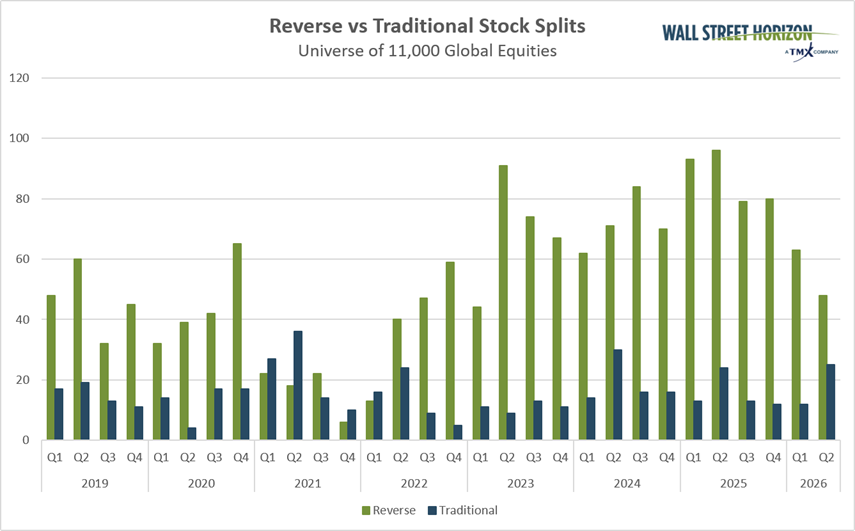
According to historical data tracked by Wall Street Horizon, corporate stock split activity has shifted away from the peak volumes seen over the last two years. Looking closely at the figures, the overall run-rate for 2026 is visibly lighter compared to 2025’s total of 410 splits. Across both the first and second quarters of 2026, corporate boards have displayed a more measured approach to altering their capital structures.

Source: Wall Street Horizon
Read more: From Stock Repurchases to AI Capex: The New Playbook for Corporate Cash
A Decline in Traditional Split Momentum
The slowdown in traditional splits is especially telling. In 2024, corporate boards authorized 76 traditional forward splits as equity prices climbed. That number moderated to 62 in 2025 and stands at just 37 for the first half of 2026 (data as of June 8).
What makes this trend particularly notable is that Q2 has historically been the calendar window where optimistic, forward-looking traditional split announcements peak. While Q2 2026 did see a relative pickup over Q1 (rising from 12 to 25 forward splits), the aggregate numbers remain remarkably modest relative to the broader indices' trading levels.
The signal behind this trend? It implies that despite strong index performance, C-suite executives may be harboring a higher degree of caution regarding operational visibility than their current earnings reports show. When leadership teams hesitate to execute forward splits, it suggests they are carefully evaluating the sustainability of their current share price baselines.
The Persistent Drumbeat of Reverse Splits
On the other side of the ledger, reverse stock splits continue to make up the vast majority of total corporate actions. While defensive adjustments have slowed from the record clip of 348 logged in 2025, the 111 reverse splits executed in the first half of 2026 show that a substantial contingent of micro- and small-cap firms are continually fighting to preserve their exchange listings.
This reflects the classic K-shaped corporate environment: while prominent market leaders command high share values, a long tail of struggling organizations must continuously execute reverse splits to avoid structural delisting risks.
High-Profile Crosscurrents: Carvana’s Strategic Signal
Even within these lighter aggregate totals, specific corporate actions offer fascinating insights into individual company dynamics.
A prominent example from the first half of the year was Carvana Co. (CVNA), which announced a traditional stock split on March 13, 2026, with an effective ex-date of May 7, 2026. Carvana’s move stands out as a clear confidence signal, bucking the broader, quieter trend seen among mid- and large-cap consumer platforms during the opening quarters of the year. By executing a forward split, management aimed to improve share accessibility and signal structural recovery to the broader market.
The Bottom Line
The corporate splits data for the first half of 2026 confirms that the equity space remains highly segmented. The drop-off in traditional stock splits may indicate that executive teams are maintaining a disciplined, watchful posture toward their capital structures, even as a steady stream of reverse splits highlights ongoing operational pressures within vulnerable sectors.
As portfolio managers and risk professionals look toward the second half of 2026, keeping a close eye on primary-sourced split announcements will remain a vital tool for reading the true health and "body language" of corporate boards.
Copyright © 2026 Wall Street Horizon, Inc. All rights reserved. Do not copy, distribute, sell or modify this document without Wall Street Horizon's prior written consent. This information is provided for information purposes only. Neither TMX Group Limited nor any of its affiliated companies guarantees the completeness of the information contained in this publication, and we are not responsible for any errors or omissions in or your use of, or reliance on, the information. This publication is not intended to provide legal, accounting, tax, investment, financial or other advice and should not be relied upon for such advice. The information provided is not an invitation to purchase securities, including any listed on Toronto Stock Exchange and/or TSX Venture Exchange. TMX Group and its affiliated companies do not endorse or recommend any securities referenced in this publication. This publication shall not constitute an offer to sell or the solicitation of an offer to buy, nor may there be any sale of any securities in any state or jurisdiction in which such offer, solicitation or sale would be unlawful prior to registration or qualification under the securities laws of any such state or jurisdiction. TMX, the TMX design, TMX Group, Toronto Stock Exchange, TSX, and TSX Venture Exchange are the trademarks of TSX Inc. and are used under license. Wall Street Horizon is the trademark of Wall Street Horizon, Inc. All other trademarks used in this publication are the property of their respective owners.
A message from Advisor Perspectives and VettaFi: Discover something new! Click here to register for our upcoming webcasts.
© Wall Street Horizon
More Innovative ETFs Topics >