First impressions count, and Kevin Warsh came out as a hawk in his first press conference as the new Federal (Fed) Reserve chair.
I was not surprised. I had been puzzled by how many people in the media and in the markets believed Warsh would come into the job simply to fulfill US President Trump's desire for lower interest rates. I have argued in public and in client meetings that, based on his track record, if anything Warsh seemed likely to be the most hawkish Fed chair we had seen since Paul Volcker in the 1980s.
His first press conference seemed to confirm this. Warsh stressed up front and repeatedly that the Fed can and will bring inflation back to the 2% target, after missing it to the upside for five straight years. He did not mince words or hide behind supply shocks. As markets found some relief in the announcement of a US-Iran deal and oil prices fell, he could have argued that the energy price shock will hopefully prove…dare I say,… “transitory.” Instead, he said the following:
“The Fed statement says that inflation is primarily determined by monetary policy. You bet it is. I've said for years inflation is a choice. You bet it is. And today I'm announcing that this Committee unambiguously and unanimously have decided we are going to deliver on that.”
And, “We’ve missed for five years, and we’re going to fix that.”
For a moment, I almost felt myself transported to an earlier stage of my career, listening to then European Central Bank (ECB) President Jean-Claude Trichet saying that inflation was the only needle in the central bank's compass.
The ECB, however, has a single mandate: its inflation target. The Fed has a dual mandate: price stability and full employment. Jay Powell had noted that a stagflationary energy shock could put the two goals in conflict, increasing inflation pressures while creating downside risks to employment and growth. Tightening monetary policy to contain inflation would then exacerbate growth risks, and vice versa. Kevin Warsh said something very different.
Read more: Chair Warsh and a New Era for the Fed
“I don't believe that we have a cruel choice. I don't share the view that […] Federal Reserve Chairmen show up at a podium like this and say you got to choose. And you're going to have to decide whether you're willing to tolerate higher inflation, to put more people at work. I don't believe in that. What I believe is if we do our job, we can make strong growth, low prices and strong employment mutually compatible.”
To be fair, Jay Powell also always said that in the long term, low and stable inflation is a necessary precondition for strong growth and employment. But the fact that Kevin Warsh chose to stress this even as the Middle East crisis is not yet fully resolved is telling.
Equally revealing was his assessment of the economic outlook and monetary policy stance. In a policy statement much shorter and factual than we've become used to, the Federal Open Market Committee characterized the pace of economic activity as solid, with strong investment and productivity growth and a stable unemployment rate in a job market that is keeping pace with labor force expansion. It acknowledged uncertainty but did not emphasize downside risks.
The monetary stance, Warsh said, could best be characterized as uneven: it seems tight if you look at the housing market, but not if you look anywhere else, particularly at the performance of financial markets. This, Warsh argued, could reflect the differential impact of different monetary policy tools like interest rates and the Fed’s balance sheet. Again, a different and more hawkish position than Jay Powell, who insisted that monetary stance was moderately restrictive—something on which I have long disagreed.
The impact of the size and composition of the Fed balance sheet will be assessed by one of five task forces that Kevin Warsh has appointed. The other four will be looking at Fed communication, data issues, the impact of innovation and new technologies, and the drivers and measurements of inflation. All will include both Fed staff and outside experts from a variety of backgrounds. With the announcement of these task forces, Kevin Warsh has indicated that he intends to overhaul the Fed's monetary policy operations, but without prejudging the outcome. On the Fed balance sheet, his preference remains clear: He has always been critical of sustained quantitative easing, and his press conference comments confirm he would prefer a smaller balance sheet.
Equally clear is his preference for parsimonious communication. The policy statement was less than half the size of previous ones. And Kevin Warsh noted that his old mentor, George Shultz, used to say that press conferences are useful but, “when you have one, you want to make sure you have something important to say.”
Here, Warsh focused on something very important, which I both agree with and have long been concerned about. Over the past 15 years, a rather unhealthy dynamic has become entrenched between the Fed and financial markets. The Fed has been using forward guidance to influence market expectations as a way of giving further power to monetary policy. Financial markets have become almost single-mindedly focused on divining what the Fed will likely do. The Fed, in turn, has become extremely reluctant to disappoint market expectations. This circular process is deleterious at least at two levels. If the Fed is concerned about validating market expectations, it cannot be guided by its best assessment of the economic data. And if markets are mostly trying to anticipate the Fed's behavior, financial prices carry little information about economic data and furthermore markets cannot be appropriately focused on fundamental risks—and price risk adequately. Warsh wants to move back toward a situation where financial markets react mostly to the economic data themselves; asset prices would then become a valuable additional source of information for the Fed. As a first step in this direction, the Warsh Fed has de facto abandoned forward guidance.
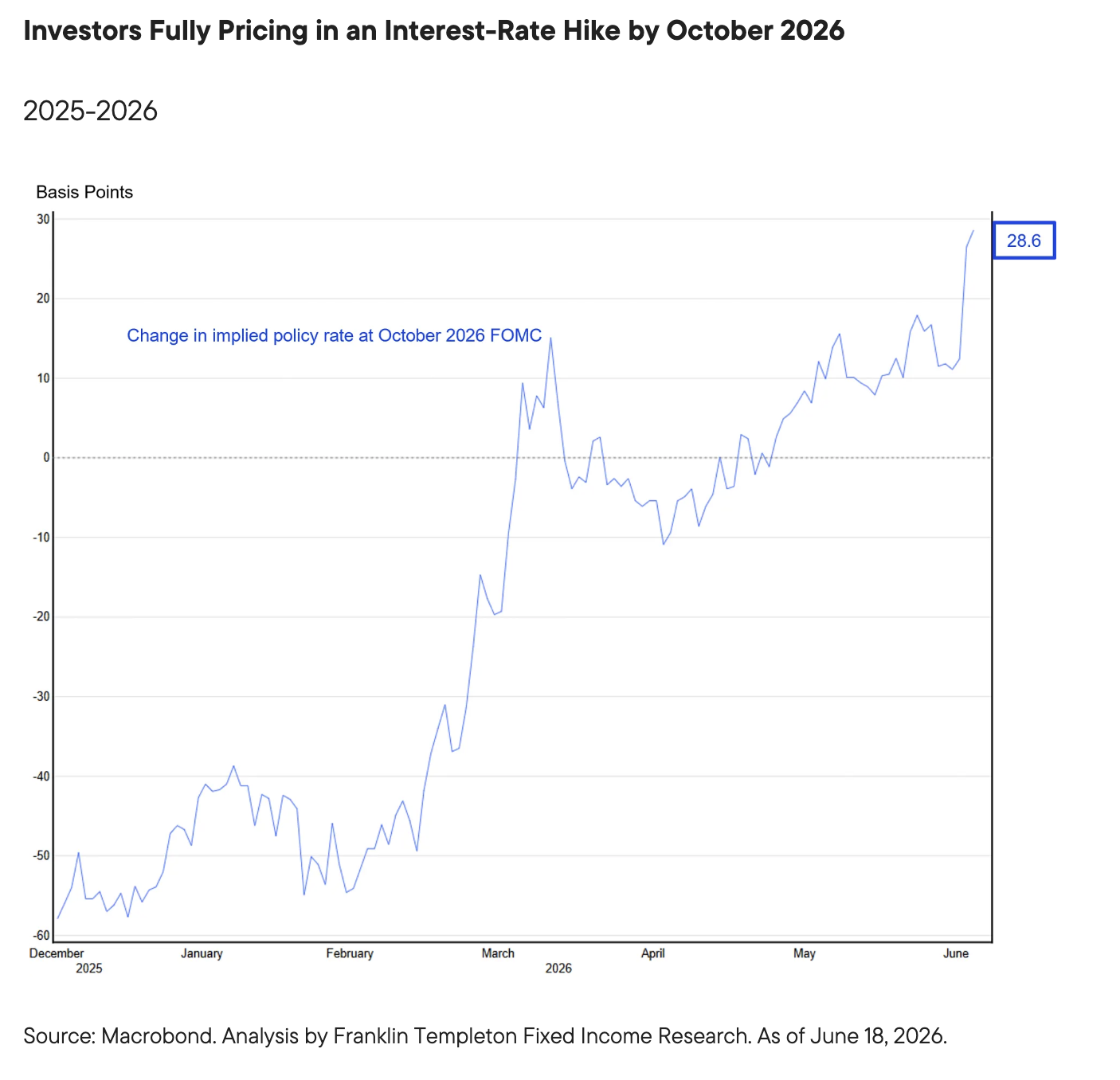
As Warsh pointed out, it will take time for all these changes to feed through the pipelines and for financial markets to digest them. The initial market reaction, however, was clear. Investors have begun to more fully price in an interest-rate hike this year, which I see as a plausible outcome. The overwhelming consensus before the press conference was that Warsh would be dovish; by contrast, his hawkish tone came as quite a surprise and led to a selloff in rates and a strengthening in the dollar.

Overall, in my view the tone of Warsh’s first press conference as Fed Chair aligns much better with the economic reality on the ground and signals a welcome return to a more orthodox monetary policy, shows determination to bring inflation back to target while the economy continues to show resilience, and casts a critical eye on the risks of an oversized balance sheet.
WHAT ARE THE RISKS?
All investments involve risks, including possible loss of principal.
Fixed income securities involve interest rate, credit, inflation and reinvestment risks, and possible loss of principal. As interest rates rise, the value of fixed income securities falls. Low-rated, high-yield bonds are subject to greater price volatility, illiquidity and possibility of default.
Equity securities are subject to price fluctuation and possible loss of principal.
International investments are subject to special risks, including currency fluctuations and social, economic and political uncertainties, which could increase volatility. These risks are magnified in emerging markets.
There is no assurance that any estimate, forecast or projection will be realized.
WF: 11075299
IMPORTANT LEGAL INFORMATION
This material is intended to be of general interest only and should not be construed as individual investment advice or a recommendation or solicitation to buy, sell or hold any security or to adopt any investment strategy. It does not constitute legal or tax advice. This material may not be reproduced, distributed or published without prior written permission from Franklin Templeton.
The views expressed are those of the investment manager and the comments, opinions and analyses are rendered as at publication date and may change without notice. The underlying assumptions and these views are subject to change based on market and other conditions and may differ from other portfolio managers or of the firm as a whole. The information provided in this material is not intended as a complete analysis of every material fact regarding any country, region or market. There is no assurance that any prediction, projection or forecast on the economy, stock market, bond market or the economic trends of the markets will be realized. The value of investments and the income from them can go down as well as up and you may not get back the full amount that you invested. Past performance is not necessarily indicative nor a guarantee of future performance. All investments involve risks, including possible loss of principal.
Any research and analysis contained in this material has been procured by Franklin Templeton for its own purposes and may be acted upon in that connection and, as such, is provided to you incidentally. Data from third party sources may have been used in the preparation of this material and Franklin Templeton ("FT") has not independently verified, validated or audited such data. Although information has been obtained from sources that Franklin Templeton believes to be reliable, no guarantee can be given as to its accuracy and such information may be incomplete or condensed and may be subject to change at any time without notice. The mention of any individual securities should neither constitute nor be construed as a recommendation to purchase, hold or sell any securities, and the information provided regarding such individual securities (if any) is not a sufficient basis upon which to make an investment decision. FT accepts no liability whatsoever for any loss arising from use of this information and reliance upon the comments, opinions and analyses in the material is at the sole discretion of the user.
Franklin Templeton has environmental, social and governance (ESG) capabilities; however, not all strategies or products for a strategy consider “ESG” as part of their investment process.
Products, services and information may not be available in all jurisdictions and are offered outside the U.S. by other FT affiliates and/or their distributors as local laws and regulation permits. Please consult your own financial professional or Franklin Templeton institutional contact for further information on availability of products and services in your jurisdiction.
Issued in the U.S. by Franklin Templeton, One Franklin Parkway, San Mateo, California 94403-1906, (800) DIAL BEN/342-5236, franklintempleton.com. Investments are not FDIC insured; may lose value; and are not bank guaranteed.
You need Adobe Acrobat Reader to view and print PDF documents. Download a free version from Adobe's website.
CFA® and Chartered Financial Analyst® are trademarks owned by CFA Institute.
A message from Advisor Perspectives and VettaFi: Discover something new! Click here to register for our upcoming webcasts.
© Franklin Templeton
More Closed End Funds Topics >