Mild Macro Data Sets up AI Tech Earnings and a Busy August Corporate Event Stretch
Membership required
Membership is now required to use this feature. To learn more:
View Membership Benefits
Key Takeawys
-
Cooling inflation and resilient consumer spending have eased economic concerns, shifting Wall Street's focus squarely to earnings
-
Big Tech results, beginning today (July 22) after the bell, offer fresh insight into AI spending trends and corporate profitability
-
Rising oil prices and Middle East tensions remain key risks that could challenge the disinflation narrative
It's difficult to call any stretch a calm, quiet summer week, but this one would seemingly fit the bill. Earnings from Alphabet (GOOGL), Tesla (TSLA), and IBM (IBM) are the standouts, along with a slew of cyclicals reporting Q2 results.
Beyond that, the Fed is in its blackout window ahead of the FOMC’s July 29 interest rate decision, and we won’t get major economic data until the end of the month.
Inflation Delivers Good News
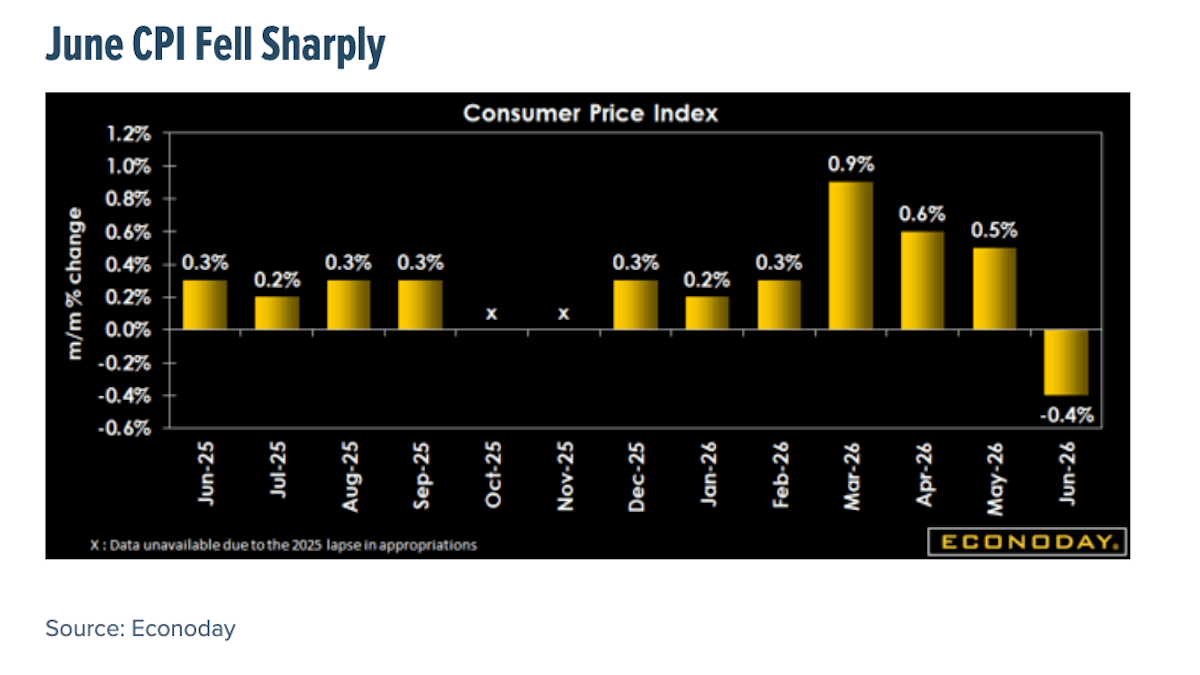
Last week offered a treasure trove of consumer clues, though. First, the June CPI report (released on Tuesday morning, July 14) came in much better than expected. According to Econoday, the 0.4% drop in the headline figure was the largest monthly decline since April 2020. The energy component fell 5.7%, while gasoline prices plunged 9.7%.
On a year-over-year basis, CPI inflation cooled to 3.5%, while the core rate ticked down by two basis points, rounding to 2.6%.
See more: Big Tech Needs to Justify AI Spending as Investors Dump Stocks
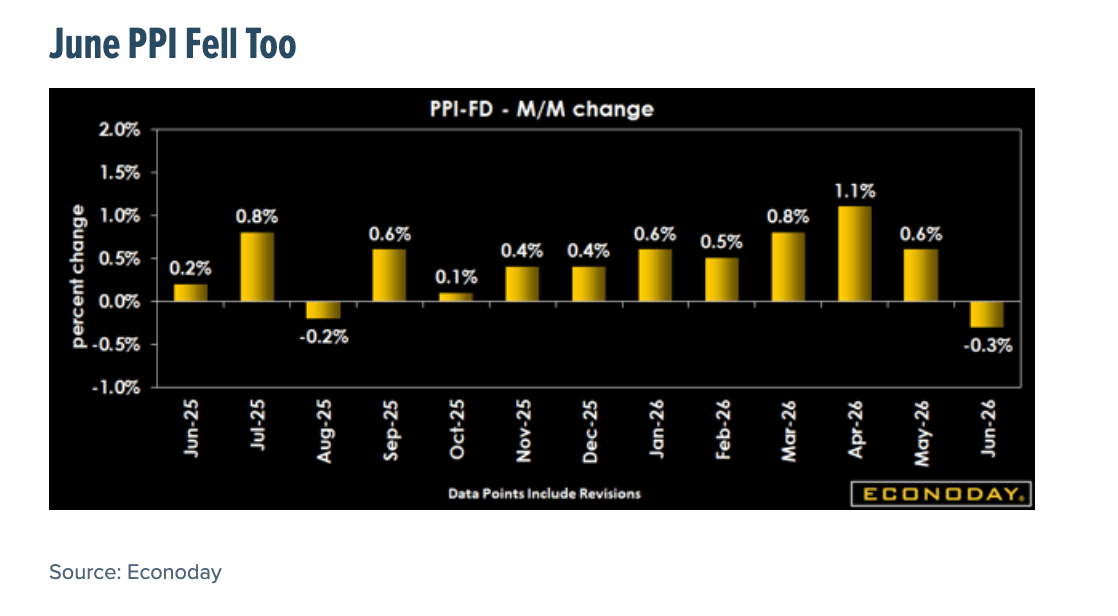
It was the first in what turned out to be a somewhat Goldilocks set of June reports. The CPI on its own flipped the Fed rate hike odds to the likelihood of a hold. The following morning, PPI data confirmed a sanguine inflation trend. Wholesale prices dipped 0.3%, aided by a 6.4% energy price retreat, helping to push goods costs lower as the first half drew to a close.
Services inflation was still apparent, however, and year-over-year PPI remained elevated at 5.5%.
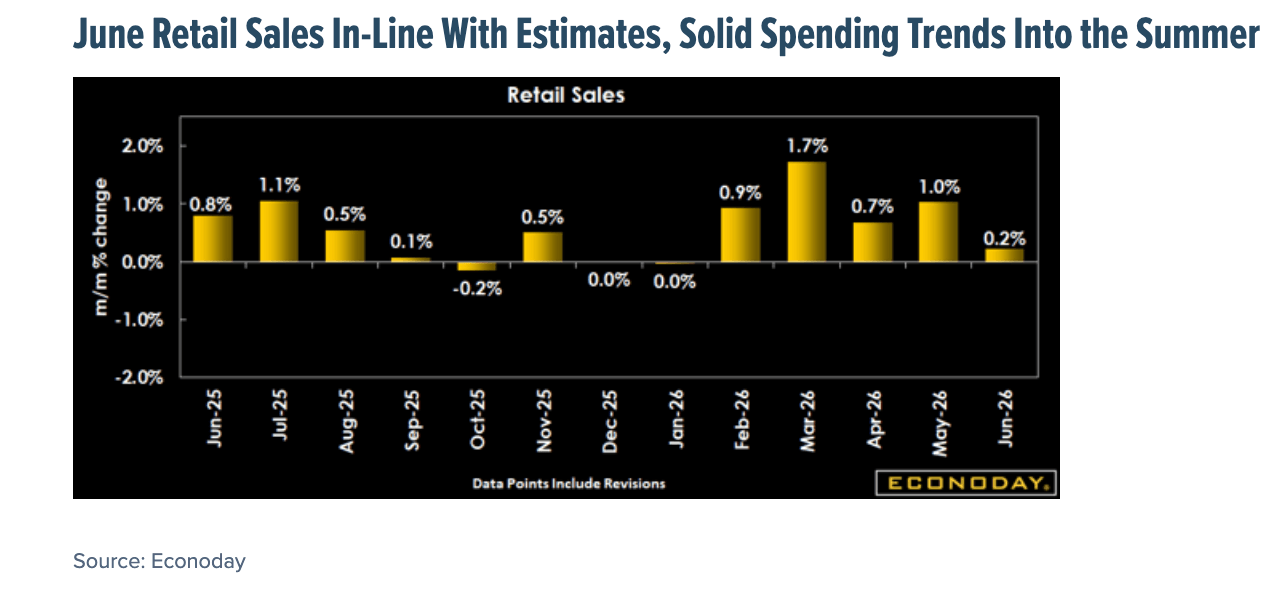
Then came Retail Sales from the U.S. Census Bureau on Thursday, July 16. This macro reading was not far from consensus, with headline spending edging up 0.2% in June, along with a stronger revised 1.0% increase in May.
On a one-year basis, retail outlays were up 6.7%, well above the prevailing inflation rate, suggesting that consumers kept shopping online, spending on travel, and gearing up around the New York Knicks' NBA Finals victory and the 2026 FIFA World Cup.
AI Spending Faces a Reality Check
What does it all mean for investors? Well, the economy keeps chugging along, in part because of the AI buildout. But a "spend at all costs" mindset has shifted to expense control on the part of major corporations, with Uber (UBER) among the notable firms to tap the brakes on model usage. Indeed, so-called "token-maxing" has given way to a more throttled mindset, just as the Q2 earnings season kicks into high gear. We’ll know more when the major AI hyperscalers and other mega-cap tech companies report quarterly results later this month.
In the rearview, IBM’s preliminary earnings report last week stunned the Street, sending shares spiraling lower for their worst day since Big Blue’s modern-era IPO in 1962. It wasn’t exactly the kind of start to the reporting period that investors hoped for. As normally scheduled revenue and profit numbers hit the tape, FactSet notes that companies missing on actual earnings have seen their stock prices get clobbered. John Butters confirmed that firms with negative surprises have seen an average stock price decline of 9% (covering the period from two days before the release through two days after). It’s a historically large percentage, while beats are barely being rewarded.
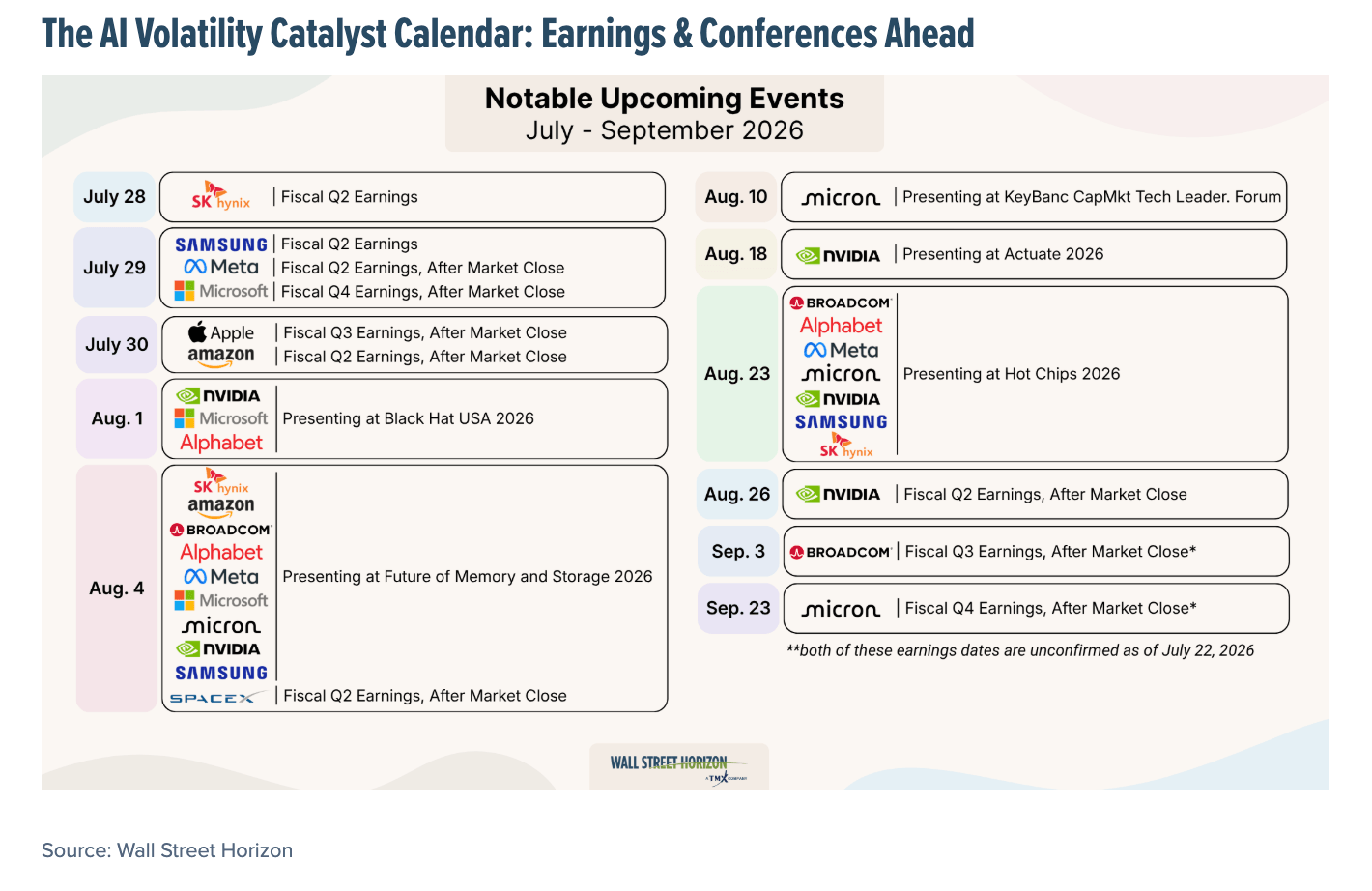
As for the key dates, following GOOGL and TSLA this week, SK Hynix, Samsung, Meta, Microsoft, Apple, and Amazon put out quarterly earnings next week. Also be on the lookout for mega-cap tech volatility in early August during the Black Hat 2026 conference (August 1-6) and the Future of Memory and Storage Conference (August 4-6). SpaceX reports Tuesday, August 4 AMC. Later in the month, the Hot Chip 2026 Conference (August 23-25) has a slew of AI leaders on the speaking docket, right before NVIDIA’s Q2 earnings hit on Wednesday, August 26 AMC.
The Fed Goes Quiet
So, investors got what they were hoping for in terms of the key June macro data. Yes, the payrolls report was soft, but weekly jobless claims are very low for this time of year, and other high-frequency indicators point to a healthy and stable labor market. Fed Chair Kevin Warsh said as much during his semiannual testimony before Congress as CPI and PPI rolled in last week.
Pressed for his views on what the FOMC may do regarding interest rate policy and the Fed’s balance sheet, Warsh was indirect. Barely two months into his tenure, wishy-washy Warsh may be apropos. That’s not an indictment, either, as Powell’s successor seeks to tone down Fed speak, restoring a more Greenspan-era communication policy.
Yes, it’s comforting to look back on the 1990s with rose-tinted glasses, but the truth is that today’s monetary policy construct is simply different. Modern Fed members feel motivated to voice opinions, and if Warsh remains quiet, other voting members will fill the void. It’s possible that, assuming the Fed holds at next week’s meeting, some hawks on the Committee will use their respective bully pulpits to tee up a September rate hike.
That could force Warsh’s hand, either squashing or confirming a quarter-point tightening at the September Fed gathering. Keep in mind that the 2026 Jackson Hole Economic Symposium, hosted by the Kansas City Fed, is slated for August 27-29. Thus, Friday, August 29, could be a crucial morning for the bond market and global investors.
Oil Is the Wild Card
In the here and now, the focus will be on earnings, along with developments in the Middle East. Brent crude oil hovers around $90 per barrel amid continued U.S. strikes on Iran, while crack spreads (the price difference between crude oil and refined products, like gasoline) are at a record level, confirming extremely tight distillate (the end products) supply-demand balances.
Traders can see this in equity price action: two of the largest U.S. refiner stocks, Marathon Petroleum (MPC) and Valero (VLO), are up 96% and 95%, respectively, so far in 2026. Commuters feel the heat, too, with the AAA average gas price topping $4 once again this week. The upshot? Higher energy prices might upend the disinflation narrative if geopolitical tensions persist.
The Bottom Line
There’s a lot for investors to weigh. Encouraging inflation and consumer spending data last week paired well with a stellar start to the Q2 earnings season. Still, "SaaSpocalypse" fears linger as the AI road twists and turns. We’ll know more as the summer plays out, with conference season ratcheting back up, back-to-school shopping numbers registering, and perhaps clues on the Fed’s next direction.
Keep up with all the macro and corporate event-level data as our team sifts through the noise to spot the signal in today’s fast-changing market.
Copyright © 2026 Wall Street Horizon, Inc. All rights reserved. Do not copy, distribute, sell or modify this document without Wall Street Horizon's prior written consent. This information is provided for information purposes only. Neither TMX Group Limited nor any of its affiliated companies guarantees the completeness of the information contained in this publication, and we are not responsible for any errors or omissions in or your use of, or reliance on, the information. This publication is not intended to provide legal, accounting, tax, investment, financial or other advice and should not be relied upon for such advice. The information provided is not an invitation to purchase securities, including any listed on Toronto Stock Exchange and/or TSX Venture Exchange. TMX Group and its affiliated companies do not endorse or recommend any securities referenced in this publication. This publication shall not constitute an offer to sell or the solicitation of an offer to buy, nor may there be any sale of any securities in any state or jurisdiction in which such offer, solicitation or sale would be unlawful prior to registration or qualification under the securities laws of any such state or jurisdiction. TMX, the TMX design, TMX Group, Toronto Stock Exchange, TSX, and TSX Venture Exchange are the trademarks of TSX Inc. and are used under license. Wall Street Horizon is the trademark of Wall Street Horizon, Inc. All other trademarks used in this publication are the property of their respective owners.
A message from Advisor Perspectives and VettaFi: Discover something new! Click here to register for our upcoming webcasts.
Membership required
Membership is now required to use this feature. To learn more:
View Membership BenefitsSponsored Content
Upcoming Virtual Events View All