Two powerful forces are shaping the economic and investment landscape. The first, as we anticipated in the Vanguard Economic and Market Outlook for 2026, is artificial intelligence, which is supporting above-trend U.S. growth. The second is the oil shock stemming from conflict in the Middle East, which has weighed on global growth and added to inflationary pressures. These forces are driving an unusual degree of divergence across regions. While the U.S. appears positioned for structural transformation, other major economies face a more challenging balance between technological change and elevated energy costs.
AI is central to our investment thesis. It is already contributing to stronger U.S. corporate earnings expectations, though elevated valuations suggest we could see periodic corrections as the transformation unfolds. Importantly, AI appears increasingly likely to become a transformative technology, creating meaningful economic upside while also setting conditions for a potential rotation in market leadership.
See more: Market Broadening Gains Momentum as AI Uncertainty Grows
U.S. economy poised for structural transformation
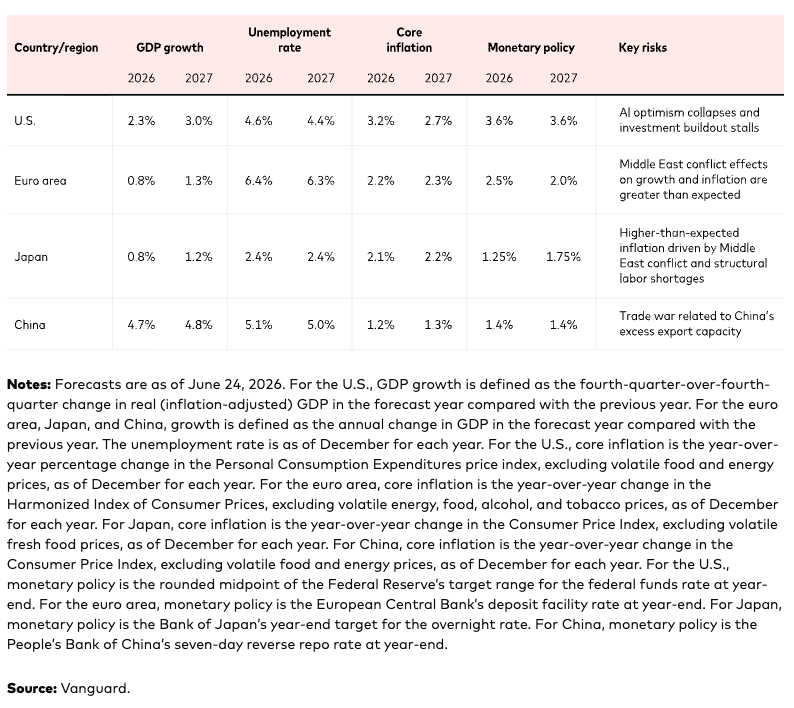
Our most notable call now is for 3% U.S. GDP growth in 2027, well above consensus forecasts. This reflects what we view as a structural transformation rather than a cyclical acceleration. Moreover, while six months ago we forecasted that the U.S. economy would eventually grow by 3%, that call was based on the investment trajectory relative to past technological revolutions.
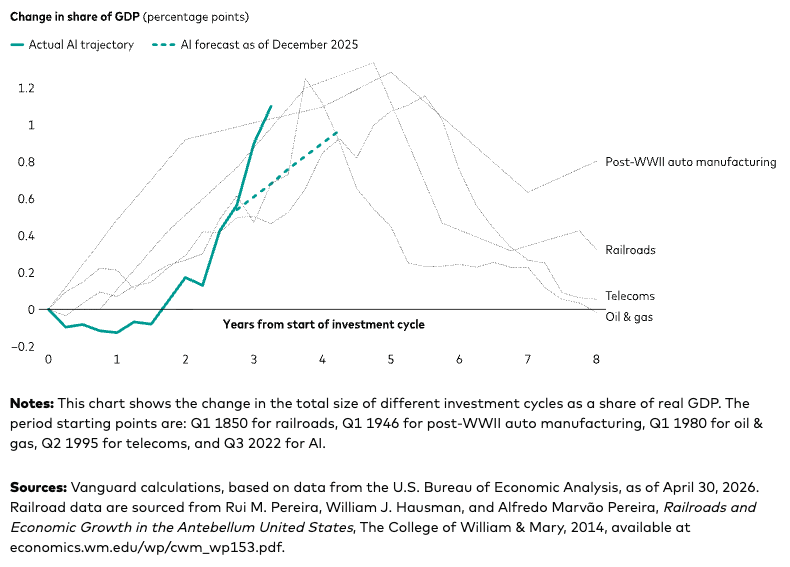
AI investment to date, however, suggests we are in the early stages of a profound economic shift that could reshape productivity over the coming decade. Recent data show AI-related capital expenditure both exceeding its elevated late-2025 levels and tracking above our predictions for 2026. This wave of investment resembles historic periods of large-scale capital expansion, such as the railroad buildout in the 19th century and the late-1990s technology boom.
The AI investment cycle is ramping up faster than expected
The U.S. remains in the early-to-middle stages of this AI-driven capital cycle, with strong investment activity likely to continue for another year or two. Large technology firms appear well positioned to sustain infrastructure spending, and enterprise adoption is expanding. This supports our view that U.S. economic strength will prove more enduring than many expect.
However, the scale of AI investment is creating near-term inflationary pressures, compounded by higher oil prices. AI-related spending is contributing to core inflation as demand rises for semiconductors, data infrastructure, and energy. Such pressures are not uncommon during periods of rapid capital deepening.
Near-term growth and longer-term productivity
The transformation will take time. In 2026, we expect U.S. GDP growth of about 2.3%. While more modest than our projection for 2027, this gain would be supported by AI investment and fiscal policy. The labor market—which cooled in 2025—is stabilizing, with unemployment likely to hover around 4.5% through 2027.
The transition from investment to broad productivity gains will take a few years to unfold. Over the longer term, we expect AI to materially boost worker productivity, lowering both production and unit labor costs across sectors. This productivity boost should also help bring down inflation over time toward the Federal Reserve’s 2% target.
The AI investment cycle is also benefiting parts of Asia. Exports have strengthened, including in China, where AI-related activity and the green transition are bolstering external demand. Despite structural headwinds domestically, we expect China’s GDP growth to register closer to 5% than 4% in both 2026 and 2027.
The oil shock has created an asymmetric drag
The oil shock driven by the Middle East conflict has pushed global benchmark crude prices at times above $100 per barrel and has contributed to global divergence in economic outlooks. More recently, progress toward a potential peace deal has contributed to a significant pullback, though crude oil prices remain roughly $10 per barrel higher than pre-conflict levels. Our analysis suggests that prices would need to exceed $150 for a period of four quarters or longer to trigger a global recession. In the near term, however, the shock has created headwinds for energy-importing countries and economies less exposed to AI-driven gains, as well as disrupting global supply chains.
The euro area is particularly exposed to oil prices. Higher energy import costs have weighed on growth and fed into consumer prices quickly. However, the magnitude of second-round effects is likely to be small (and less than that of the 2022 shock triggered by the war in Ukraine). That’s because the region comes into this shock from a position of relative strength, with headline inflation close to the 2% target set by the European Central Bank (ECB). Europe is lagging the U.S. in AI investment and resides mostly outside the global AI supply chain, limiting the growth offsets that could otherwise cushion the shock.
Global headline inflation has risen with energy prices, but pass-through to core inflation remains limited. Long-term inflation expectations that remain anchored and the expectation of the unwinding of the shock are helping to contain broader price pressures. Nonetheless, Europe remains more exposed due to its reliance on imported energy.
Inflation is pressuring monetary policy
The likelihood that the Federal Reserve will increase its policy interest rate target has increased owing to the combination of persistent price pressures and strong economic growth amid a stable labor market.
The Bank of Japan is continuing its gradual monetary policy normalization. Sustained inflation pressure, solid wage growth, and a weaker yen support expectations for further rate increases through 2026 and 2027, a notable shift after decades focused on deflation.
The ECB and Bank of England will likely implement limited “insurance” adjustments to prevent energy-driven inflation from becoming entrenched. These moves would then likely be reversed as energy pressures fade.
Tension between transformative and cyclical forces
In sum, the global outlook reflects tension between transformative and cyclical forces. AI is laying the foundation for a period of structurally stronger growth—particularly in the United States—while the oil shock is creating near-term inflationary pressure and regional divergence in economic outlooks. Although markets may experience volatility amid elevated valuations, the longer-term trajectory points to broader productivity gains as AI adoption diffuses across industries and regions.
Vanguard’s 2026 and 2027 economic forecasts
Notes:
All investing is subject to risk, including possible loss of principal.
Diversification does not ensure a profit or protect against a loss.
Stocks of companies based in emerging markets are subject to national and regional political and economic risks and to the risk of currency fluctuations. These risks are especially high in emerging markets.
Funds that concentrate on a relatively narrow market sector face the risk of higher share-price volatility.
Past performance is no guarantee of future results.
A message from Advisor Perspectives and VettaFi: Discover something new! Click here to register for our upcoming webcasts.
Jumana Saleheen, Vanguard Chief Economist, Europe, and Thiago Ferreira, Vanguard Senior Economist.
Vanguard funds not held in a brokerage account are held by The Vanguard Group, Inc., and are not protected by SIPC. Brokerage assets are held by Vanguard Brokerage Services, a division of Vanguard Marketing Corporation, member FINRA and SIPC.
For additional financial information on Vanguard Marketing Corporation, see its Statement of Financial Condition: Audited and Unaudited
Broker-Dealer Form Client Relationship Summary (Form CRS) and Investment Advisor Form Client Relationship Summary (Form CRS)
© 1995–2026 The Vanguard Group, Inc. All rights reserved. Vanguard Marketing Corporation, Distributor of the Vanguard Funds. Your use of this site signifies that you accept our terms & conditions of use.
© Vanguard
Read more commentaries by Vanguard