The Big Shareholder Diluters Are Out of Vogue
Membership required
Membership is now required to use this feature. To learn more:
View Membership Benefits
Key Takeaways
- Investors are increasingly favoring companies that reduce share counts over those issuing new equity, with buyback-oriented stocks outperforming since mid-May as sentiment toward shareholder dilution has weakened.
- Financials are leading in share reduction activity, while Technology has shifted into net dilution, highlighting how capital allocation is becoming a more important driver of sector performance.
- As markets place a greater premium on shareholder-friendly capital allocation, companies that consistently combine buybacks with dividends may be better positioned to outperform.
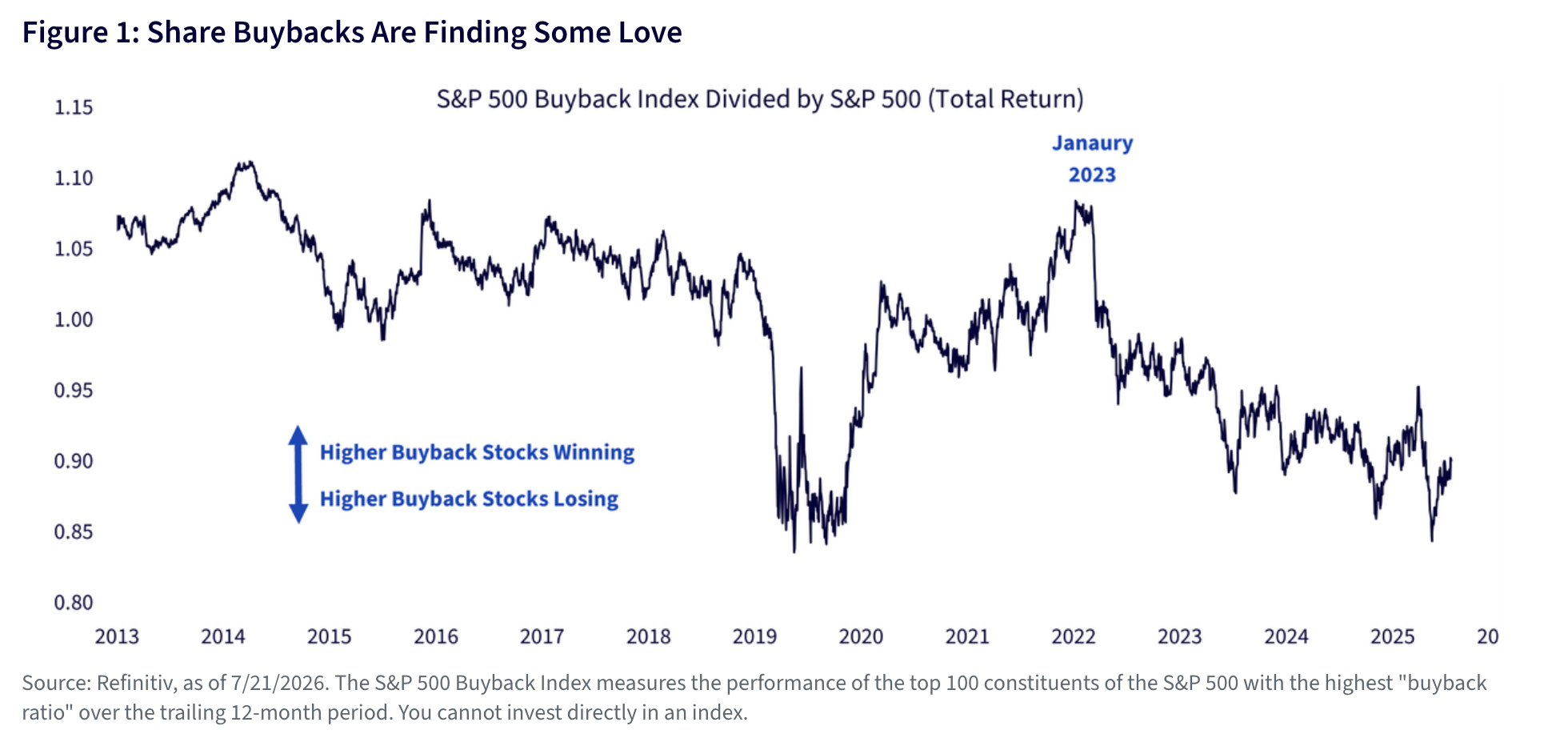
The pain in diluters is good news for some of our mandates, because companies who reduce share count have been struggling since January 2023 (Figure 1). But notice how “share buybackers” have been outperforming since May 14?
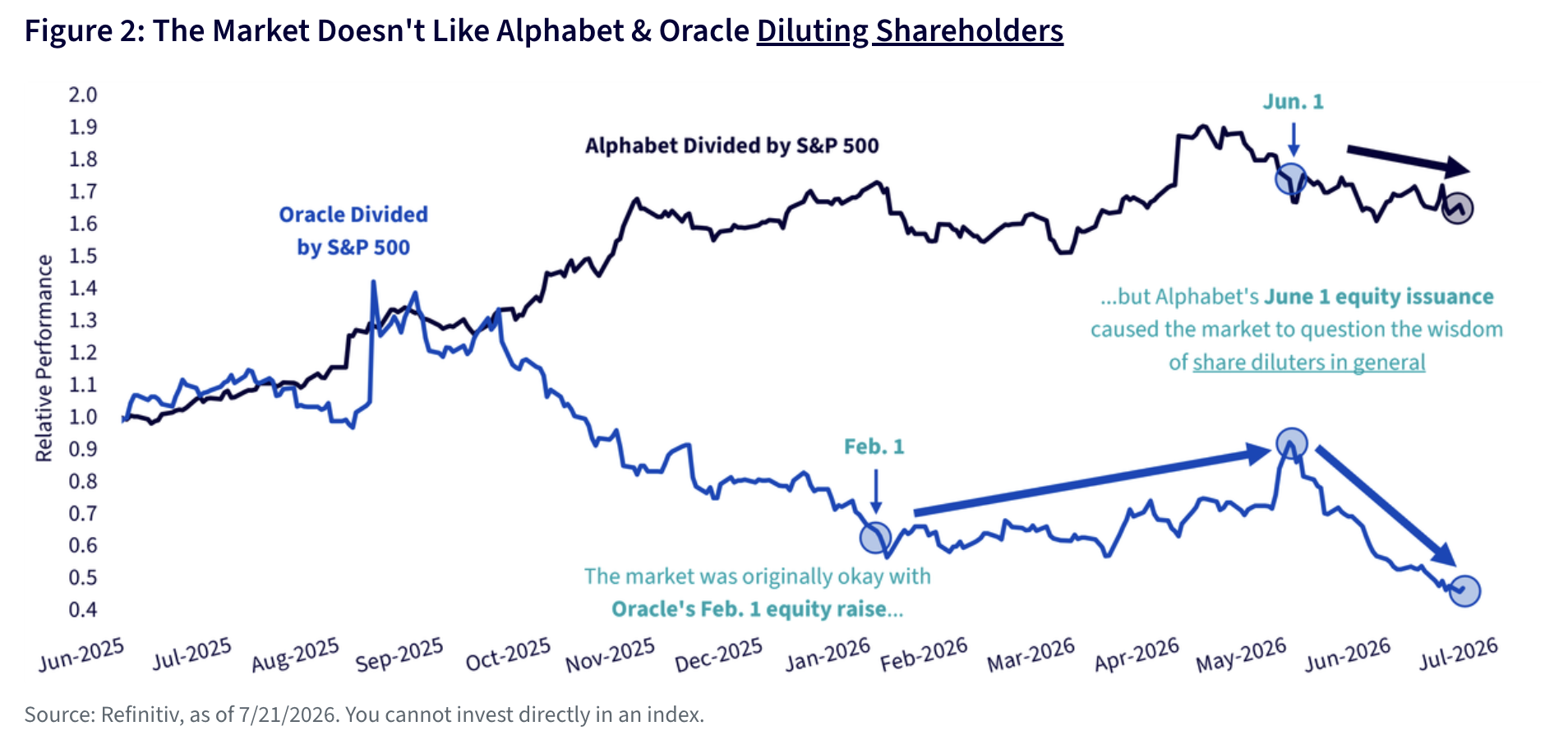
The market was originally comfortable with Oracle's $45-50bn equity, preferred and debt raise on February 1. The stock rallied throughout the spring. However, when Alphabet also announced an $80bn equity capital raise on June 1, suddenly this was starting to look like a trend. Alphabet's stock turned lower, pulling Oracle down with it (Figure 2).
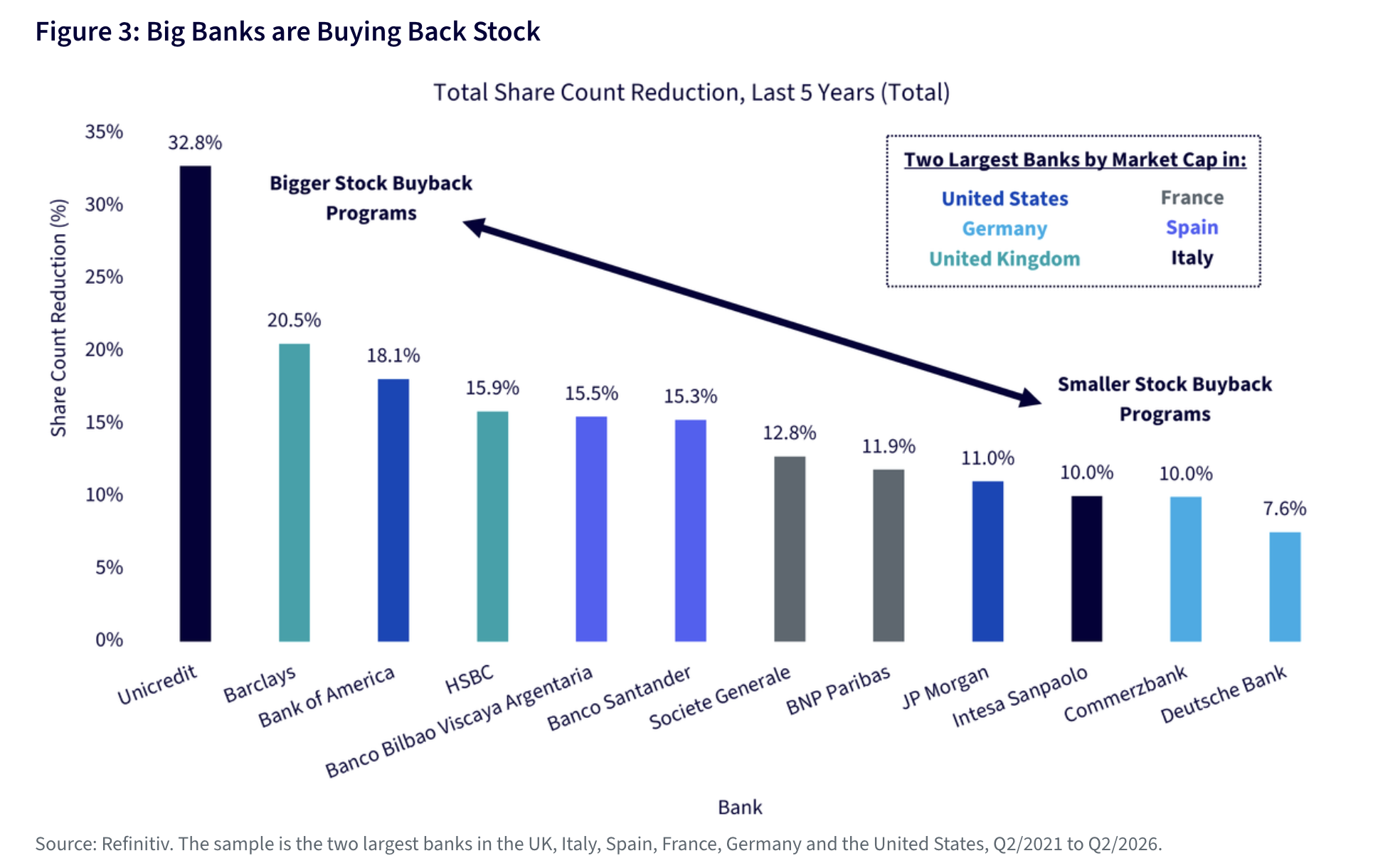
Meanwhile, one group has had a particularly strong summer: Financials. While Oracle and Alphabet expand their share count, the banking behemoths are buying (Figure 3).
See more: Investment-Grade Corporate Bonds Are Offering Real Income. That's Not Why You Should Be Nervous.
If a company has 100 shares outstanding and reduces the share count to 98, the share reduction yield is 2%.
At 2.5%, the Financials sector has a share reduction yield well north of the S&P 500’s 0.3%. Other relative winners this summer include Staples (0.6%), Communication Services (0.7%) and Healthcare (0.7%), each of which has a higher share reduction yield than the market.
Tech’s share reduction yield is -0.4%, pushed into dilution mode. The sector is also the market’s trouble spot this summer.
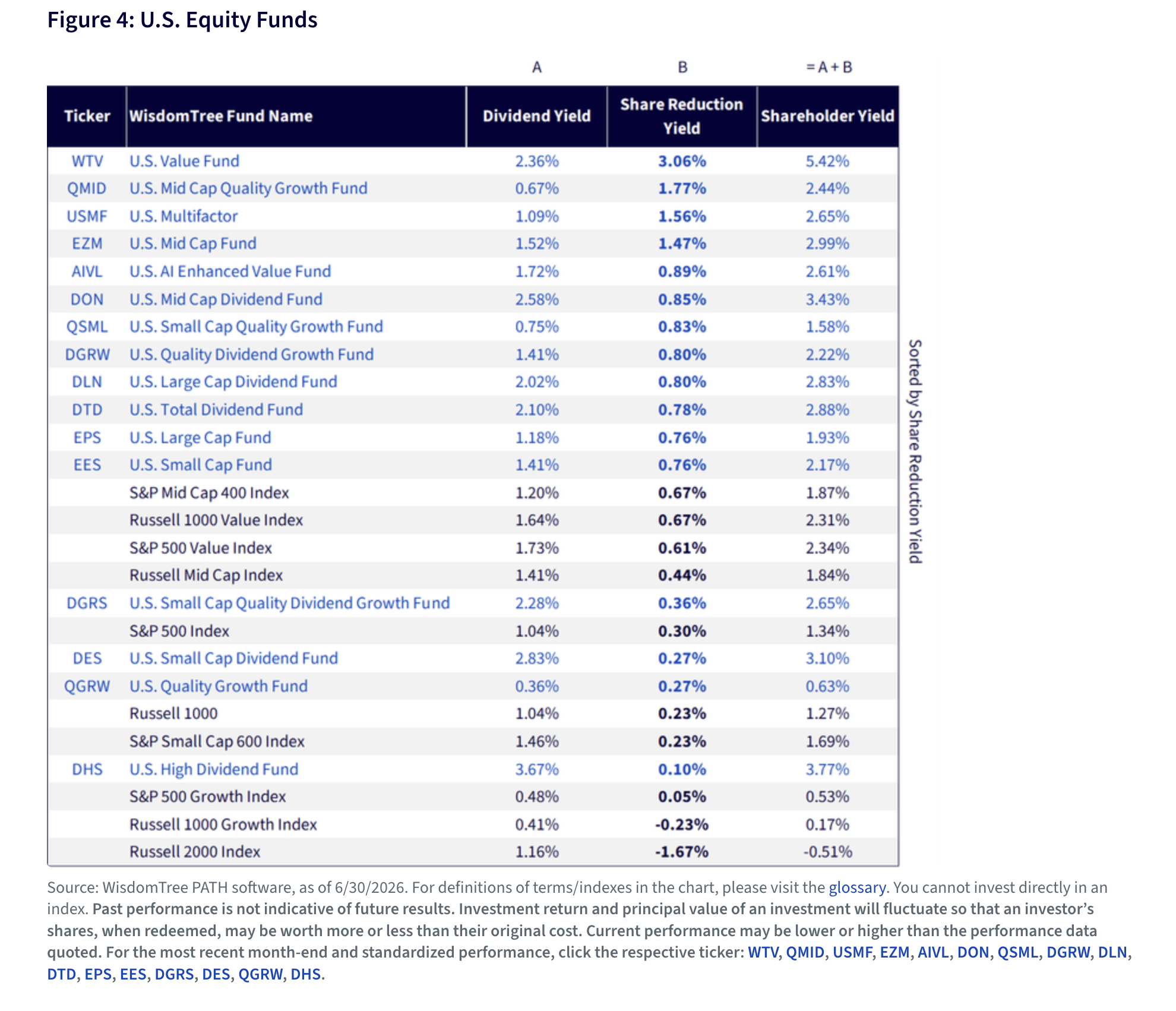
Figure 4 shows our U.S. equity list sorted by share reduction yield.
Jeff Weniger, CFA, has been with WisdomTree since 2017 and serves as the Head of Equities.
Important Risks Related to this Article
There are risks associated with investing, including possible loss of principal. Please read the Fund’s prospectus for specific details regarding the Fund’s risk profile.
WTV: Value stocks, as a group, may be out of favor with the market and underperform growth stocks or the overall equity market. Funds focusing their investments on certain sectors increase their vulnerability to any single economic or regulatory development. This may result in greater share price volatility. While the Fund is actively managed, the Fund’s investment process is heavily dependent on quantitative models and the models may not perform as intended.
QMID: Growth stocks, as a group, may be out of favor with the market and underperform value stocks or the overall equity market. Growth stocks are generally more sensitive to market movements than other types of stocks. The Fund is non-diversified, as a result, changes in the market value of a single security could cause greater fluctuations in the value of Fund shares than would occur in a diversified fund. The Fund invests primarily in the securities of mid-capitalization companies. As a result, the Fund’s performance may be adversely affected if securities of these companies underperform securities of other capitalization ranges or the market as a whole. Securities of mid-capitalization companies are often less stable and more vulnerable to market volatility and adverse economic developments than securities of larger companies, but mid-capitalization companies may also underperform the securities of small-capitalization companies because medium capitalization companies are more mature and are subject to slower growth during economic expansion. The Fund invests in the securities included in, or representative of, its Index regardless of their investment merit and the Fund does not attempt to outperform its Index. The composition of the Index is governed by an Index Committee, and the Index may not perform as intended.
USMF: Investing in a Fund exposed to particular sectors increases the vulnerability to any single economic, political or regulatory development. This may result in greater share price volatility. The Fund’s investment strategy may result in a high portfolio turnover rate. Higher portfolio turnover which may result in the Fund paying higher transaction costs and the distribution of additional, which may generate greater tax liabilities. capital gain distributions than other ETFs. The Fund invests in the securities included in, or representative of, its Index regardless of their investment merit and the Fund does not attempt to outperform its Index.
EZM: The fund invests primarily in the securities of mid-capitalization companies. As a result, the Fund's performance may be adversely affected if securities of these companies underperform securities of other capitalization ranges or the market as a whole. The Fund invests in the securities included in, or representative of, its Index regardless of their investment merit and the Fund does not attempt to outperform its Index. The composition of the Index is governed by an Index Committee and the Index may not perform as intended.
AIVL: Funds focusing their investments on certain sectors increase their vulnerability to any single economic or regulatory development. This may result in greater share price volatility. While the Fund is actively managed, the Fund’s investment process is heavily dependent on a quantitative model and the model may not perform as intended.
DON: The fund invests primarily in the securities of mid-capitalization companies. As a result, the Fund's performance may be adversely affected if securities of these companies underperform securities of other capitalization ranges or the market as a whole. Dividends are not guaranteed, and a company currently paying dividends may cease paying dividends at any time. The Fund invests in the securities included in, or representative of, its Index regardless of their investment merit and the Fund does not attempt to outperform its Index. The composition of the Index is governed by an Index Committee and the Index may not perform as intended.
QSML: Growth stocks, as a group, may be out of favor with the market and underperform value stocks or the overall equity market. Growth stocks are generally more sensitive to market movements than other types of stocks. Funds focusing their investments on certain sectors and/or smaller companies increase their vulnerability to any single economic or regulatory development. This may result in greater share price volatility. The Fund is non-diversified, as a result, changes in the market value of a single security could cause greater fluctuations in the value of Fund shares than would occur in a diversified fund. The securities of small-capitalization companies generally trade in lower volumes and are subject to greater and more unpredictable price changes than larger capitalization stocks or the stock market as a whole. Small-capitalization companies may be particularly sensitive to adverse economic developments as well as changes in interest rates, government regulation, borrowing costs and earnings. The Fund invests in the securities included in, or representative of, its Index regardless of their investment merit. The Fund does not attempt to outperform its Index. The composition of the Index is governed by an Index Committee and the Index may not perform as intended.
DGRW: Growth stocks, as a group, may be out of favor with the market and underperform value stocks or the overall equity market. Growth stocks are generally more sensitive to market movements than other types of stocks. Dividends are not guaranteed, and a company currently paying dividends may cease paying dividends at any time. The Fund is non-diversified, as a result, changes in the market value of a single security could cause greater fluctuations in the value of Fund shares than would occur in a diversified fund. The Fund invests in the securities included in, or representative of, its Index regardless of their investment merit and the Fund does not attempt to outperform its Index. The composition of the Index is governed by an Index Committee and the Index may not perform as intended.
DLN: The Fund invests primarily in the securities of large-capitalization companies. As a result, the Fund’s performance may be adversely affected if securities of these companies underperform securities of smaller capitalization companies or the market as a whole. Dividends are not guaranteed, and a company currently paying dividends may cease paying dividends at any time. The Fund invests in the securities included in, or representative of, its Index regardless of their investment merit and the Fund does not attempt to outperform its Index. The composition of the Index is governed by an Index Committee and the Index may not perform as intended.
DTD: Funds focusing their investments on certain sectors increase their vulnerability to any single economic or regulatory development. This may result in greater share price volatility. Dividends are not guaranteed, and a company currently paying dividends may cease paying dividends at any time. The Fund is non-diversified, as a result, changes in the market value of a single security could cause greater fluctuations in the value of Fund shares than would occur in a diversified fund. The Fund invests in the securities included in, or representative of, its Index regardless of their investment merit. The Fund does not attempt to outperform its Index. The composition of the Index is governed by an Index Committee and the Index may not perform as intended.
EPS: The Fund invests primarily in the securities of large-capitalization companies. As a result, the Fund’s performance may be adversely affected if securities of these companies underperform securities of smaller capitalization companies or the market as a whole. The Fund invests in the securities included in, or representative of, its Index regardless of their investment merit and the Fund does not attempt to outperform its Index. The composition of the Index is governed by an Index Committee and the Index may not perform as intended.
EES: Funds focusing their investments on certain sectors and/or smaller companies increase their vulnerability to any single economic or regulatory development. This may result in greater share price volatility. The securities of small-capitalization companies generally trade in lower volumes and are subject to greater and more unpredictable price changes than larger capitalization stocks or the stock market as a whole. Small-capitalization companies may be particularly sensitive to adverse economic developments as well as changes in interest rates, government regulation, borrowing costs and earnings. The Fund invests in the securities included in, or representative of, its Index regardless of their investment merit and the Fund does not attempt to outperform its Index. The composition of the Index is governed by an Index Committee and the Index may not perform as intended.
DGRS: Growth stocks, as a group, may be out of favor with the market and underperform value stocks or the overall equity market. Growth stocks are generally more sensitive to market movements than other types of stocks. Funds focusing their investments on certain sectors and/or smaller companies increase their vulnerability to any single economic or regulatory development. This may result in greater share price volatility. The Fund is non-diversified, as a result, changes in the market value of a single security could cause greater fluctuations in the value of Fund shares than would occur in a diversified fund. The securities of small-capitalization companies generally trade in lower volumes and are subject to greater and more unpredictable price changes than larger capitalization stocks or the stock market as a whole. Small-capitalization companies may be particularly sensitive to adverse economic developments as well as changes in interest rates, government regulation, borrowing costs and earnings. Dividends are not guaranteed, and a company currently paying dividends may cease paying dividends at any time. The Fund invests in the securities included in, or representative of, its Index regardless of their investment merit and the Fund does not attempt to outperform its Index. The composition of the Index is governed by an Index Committee and the Index may not perform as intended.
DES: Funds focusing their investments on certain sectors and/or smaller companies increase their vulnerability to any single economic or regulatory development. This may result in greater share price volatility. The securities of small-capitalization companies generally trade in lower volumes and are subject to greater and more unpredictable price changes than larger capitalization stocks or the stock market as a whole. Small-capitalization companies may be particularly sensitive to adverse economic developments as well as changes in interest rates, government regulation, borrowing costs and earnings. Dividends are not guaranteed, and a company currently paying dividends may cease paying dividends at any time. The Fund invests in the securities included in, or representative of, its Index regardless of their investment merit and the Fund does not attempt to outperform its Index.
QGRW: Growth stocks, as a group, may be out of favor with the market and underperform value stocks or the overall equity market. Growth stocks are generally more sensitive to market movements than other types of stocks. The Fund is non-diversified, as a result, changes in the market value of a single security could cause greater fluctuations in the value of Fund shares than would occur in a diversified fund. The Fund invests in the securities included in, or representative of, its Index regardless of their investment merit and the Fund does not attempt to outperform its Index. The composition of the Index is governed by an Index Committee and the Index may not perform as intended.
DHS: Dividends are not guaranteed, and a company currently paying dividends may cease paying dividends at any time. Funds focusing their investments on certain sectors and/or regions increase their vulnerability to any single economic or regulatory development. The Fund invests in the securities included in, or representative of, its Index regardless of their investment merit and the Fund does not attempt to outperform its Index. The composition of the Index is governed by an Index Committee and the Index may not perform as intended.
A message from Advisor Perspectives and VettaFi: Discover something new! Click here to register for our upcoming webcasts.
Membership required
Membership is now required to use this feature. To learn more:
View Membership BenefitsSponsored Content
Upcoming Virtual Events View All