Things change fast in artificial intelligence. One minute corporate desk jockeys are competing to use AI coding and reasoning tools as much as possible, the next their bosses are complaining about budgets being pulverized and start rationing usage. Now OpenAI Chief Executive Officer Sam Altman concedes that costs have become a “huge issue” for customers and he’s reportedly considering “drastically” cutting prices to rein in rival Anthropic PBC’s lead in the corporate market.
None of this bodes well for both companies’ forthcoming initial public offerings.
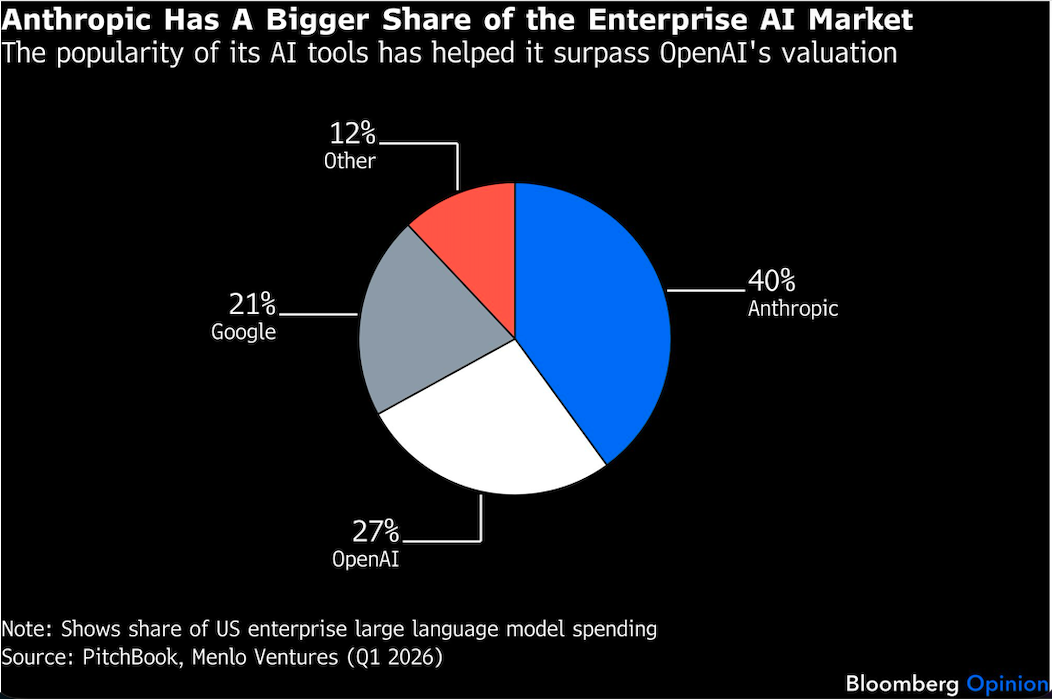
I’m not surprised Altman is on the offensive. OpenAI is the more financially reckless of the pair, and is expected to burn through eye-watering sums of money before it hopefully starts bringing in more cash than it spends by about 2030. Dario Amodei’s younger company is valued more highly: $965 billion compared with OpenAI’s mere $852 billion.
This prospect of a price war is deeply uncomfortable for “hyperscaling” tech giants such as Amazon.com Inc. and Microsoft Corp. who’ve been spending wildly on AI infrastructure so they can sell computing capacity to the big AI firms. The cost of components going into these data centers keeps rising, so any threat to OpenAI and Anthropic profits (and thereby their own ability to keep spending) is troubling.
Shares of Oracle Corp. fell in pre-market trading on Thursday because of worries about its heavy data-center investments.
Pricing is also an Anthropic concern. Its popular Claude Code tool, which automates software engineering, prompted a recent wave of corporate FOMO. If businesses start to fret more about the ballooning expense of running these AIs, or seek cheaper alternatives, its blistering revenue expansion could slow.
Altman’s remarks about the expense of AI tools at least validates Anthropic’s approach of going after business customers rather than fickle consumers, who are even more cost sensitive. Lower prices could help Amodei’s firm increase sales even faster. But a price war might delay its path to sustained profitability and puncture its near trillion-dollar valuation.

The buzz around Claude Code is why Anthropic is valued more highly than OpenAI right now. The company’s revenue run-rate — the amount it would generate if current demand persists over the next 12 months — has reached $47 billion. That’s astonishing for a five-year-old startup. Six months ago the same metric was roughly five times smaller.
Having been more cautious than OpenAI about splurging on computing capacity, Anthropic is reportedly about to complete its first profitable quarter.1
Nonetheless, doubts about a frothy market may be warranted. Michael Burry, who made his name betting against US house prices, warns that AI labs are benefiting from a "crazy, rushed, temporary phase” and that the “market is capitalizing the most expensive phase of AI adoption as if it were normal and indicative of future demand.”
One needn’t be bearish about AI’s long term prospects — I’m not — to worry that OpenAI and Anthropic have been enjoying a sugar rush.
Businesses are terrified of being left behind and are eager to gain a profit advantage from AI. But their loosening of the purse strings has encouraged staff to indulge in “tokenmaxxing,” where the heaviest use of AI tools is a badge of honor and a sign of productivity — even when there’s not much to show for it. These corporate AI users often default to expensive state-of-the-art models, too, when a less sophisticated tool might have sufficed.
One unnamed company apparently spent half a billion dollars in a single month, having failed to set Claude usage limits.
As my colleagues Parmy Olson and Lionel Laurent have written, corporate bills are rising and the unchecked use of AI agents is starting to be curtailed. More boards are asking whether AI is delivering a return on their investment.
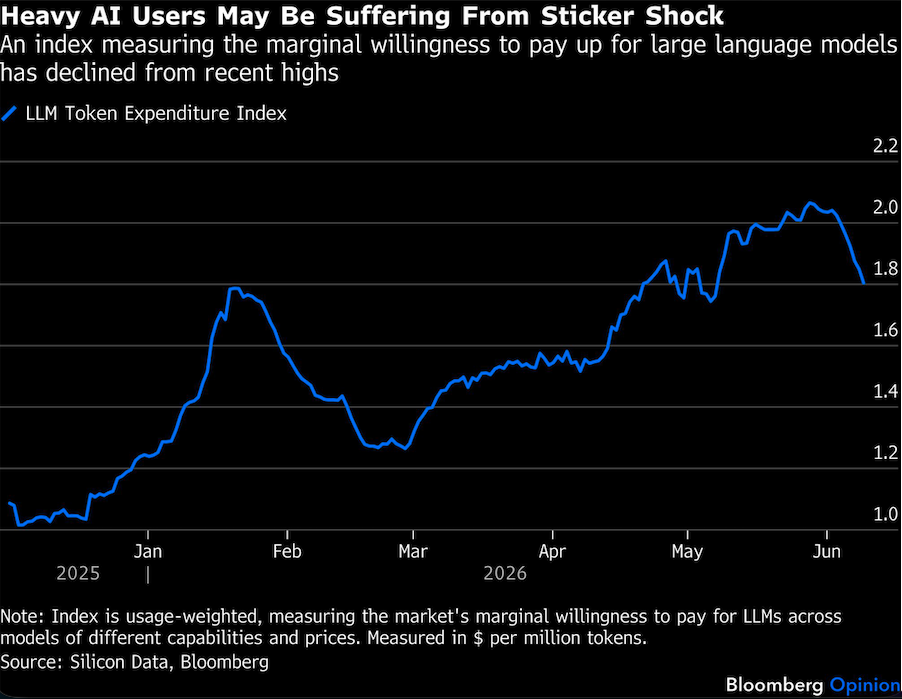
Silicon Data’s LLM Token Expenditure Index — a gauge of AI users’ willingness to pay for advanced large language models compared with cheaper solutions — has pulled back from recent highs, possibly indicating AI sticker shock. A likely explanation is that “users aren't abandoning premium models outright; they’re optimizing mixes,” Steve Hou, Silicon Data’s head of research, tells me.
While US companies might not want to trust their data to Chinese firms such as DeepSeek, there are plenty of options to choose from via AI model aggregators such as OpenRouter. In some cases an LLM — built at great expense on vast data sets — might not be necessary. So-called small language models with fewer parameters and lower computational needs may be enough.
Gil Luria, head of technology research at DA Davidson, sees parallels with the pandemic period, when companies invested heavily in shifting software to the cloud before tapping the brakes when they realized expenses were getting out of control. “The same reckoning will happen in AI — the question is, is it in the next few months, the next year or later?” he asks.
Anthropic and its ilk are about to find out how sticky their products are and whether a price war or a shift to “good enough” AI tools could cap their financial potential.
The broader industry is beginning to respond. During an earnings call on Wednesday, Oracle said it would roll out “outcome-based” pricing to better align the cost of using AI with the value you extract from it. And Anthropic isn’t sitting still, having recently unveiled a partnership with finance firms Blackstone Inc., Hellman & Friedman and Goldman Sachs Group Inc. to help more enterprise customers deploy Claude.
Amodei’s firm didn’t respond when I emailed this week to ask whether its explosive growth is sustainable. He has previously acknowledged that AI labs face a “hellish demand prediction problem.” That’s because they must commit to buying computing capacity well in advance of when it’s needed. Anthropic struggled to keep up with demand earlier this year because it didn’t have enough data centers.
Emboldened by its growth, it’s stepped on the gas, signing a $1.25 billion a month deal to rent processing capacity from Elon Musk’s SpaceX and agreeing massive compute deals with Alphabet Inc. and Amazon.com.
Still, unless its sales keep accelerating, the burden of these higher computing costs alongside a price war could mean any profits are fleeting. It’s a pity then that Anthropic and OpenAI are rushing to go public just as some of these doubts are emerging. Expect some difficulties ahead.
1. On an operating profit basis excluding stock based compensation. Anthropic's SpaceX computing deal includes discounted pricing during May and June which helps too. Profit isn’t the same as cash flow, which likely remains negative
A message from Advisor Perspectives and VettaFi: Discover something new! Click here to register for our upcoming webcasts.
Bloomberg News provided this article. For more articles like this please visit
bloomberg.com.
More Innovative ETFs Topics >