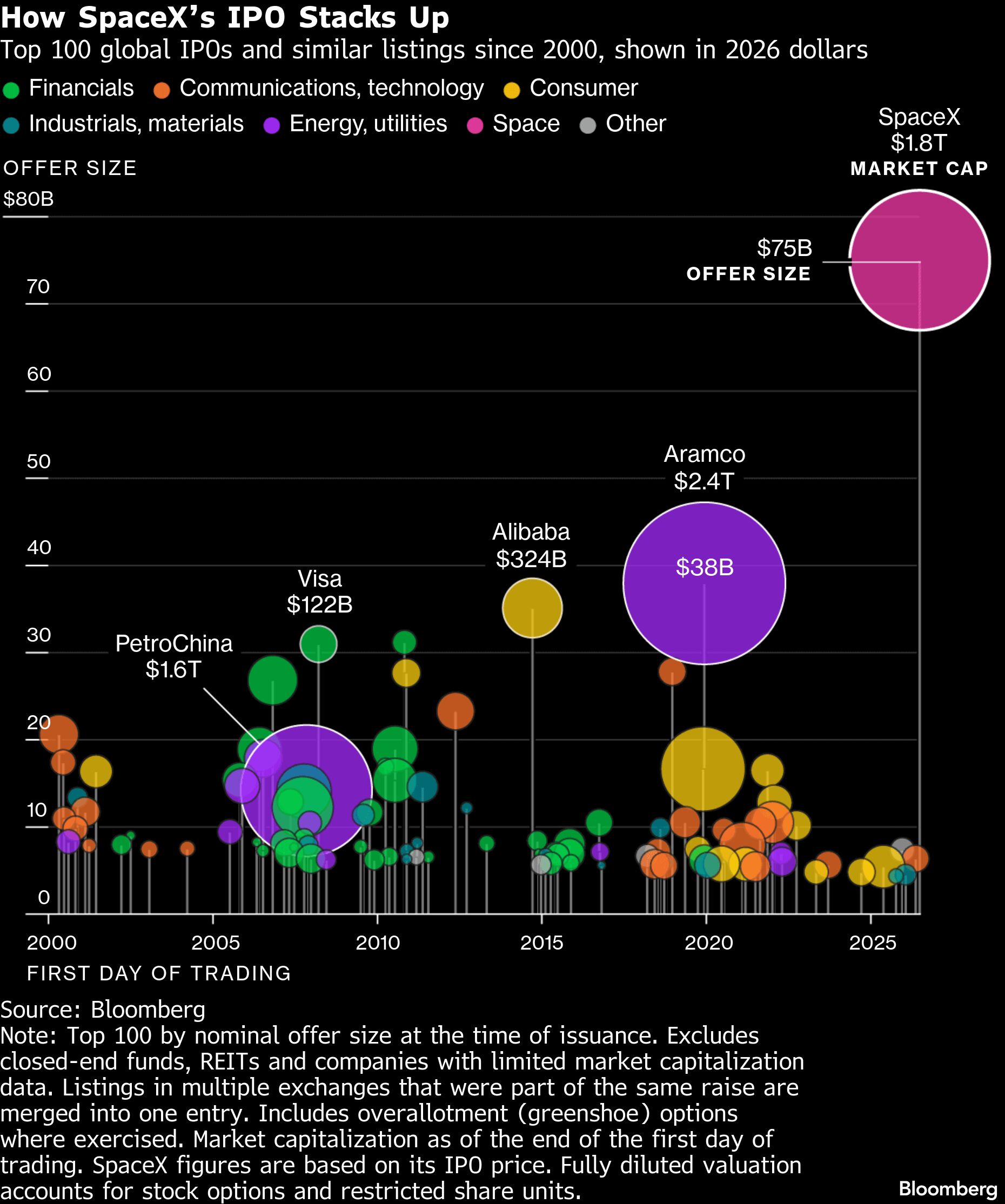
SpaceX made history with a $75 billion IPO that instantly turned it into one of the biggest public companies in the world. Now it has to win over the market.
Friday’s trading will be a critical test for the $1.8 trillion rocket, satellite and artificial intelligence company and Elon Musk, its founder. Even after raising the largest-ever amount in an IPO, SpaceX still needs the market’s validation of its ambition to dominate AI and carry humans to the moon and Mars, as well as the company’s controversial governance regime that promises Musk near-total control.
“Scaling is very expensive,” SpaceX President Gwynne Shotwell told CNBC. “The things that we’re doing cost a lot to do.” Even as a public company, SpaceX will focus on long-term horizons and less on quarterly performance, Shotwell said.
Indications of where SpaceX shares could open are expected to start flowing at some point after the market opens at 9:30 a.m. in New York. Shadow markets are pricing a blockbuster debut, indicating a pop of at least 35% from the $135 offering price.
At the Nasdaq MarketSite building in New York’s Time Square, Shotwell and SpaceX Chief Financial Officer Bret Johnsen arrived a couple of hours before the exchange’s official open, making their way through a crowd of paparazzi, private security guards and police. Conspicuously absent was Musk himself, though his mother Maye was among the first to arrive.
The IPO was more than four times oversubscribed on Thursday, Bloomberg News reported. The company’s unusual move to set a fixed price and size left bankers unable to capture surging interest, leaving a vast group of would-be buyers jockeying for whatever they can get and potentially setting up a roaring first day for the stock.
Still, the unprecedented size of SpaceX’s debut makes the market mechanics more complicated, and the fear of unexpected glitches like the ones that derailed Facebook’s IPO in 2012 is guaranteed to keep executives on edge. The first trading day will not only set the tone for future sessions, it will affect the prospects for a pair of potential giant initial public offerings from SpaceX’s AI rivals Anthropic PBC and OpenAI.
“It presages a pretty sizable wave of IPOs,” John Waldron, president of Goldman Sachs Group Inc., said during a Bloomberg Television interview with Francine Lacqua. “The capital markets are willing to finance these extraordinary companies as we build out AI infrastructure.”
The trading is also set to determine whether Musk becomes the world’s first trillionaire, a title that currently just exceeds his grasp. Musk’s fortune sits at about $970 billion as of Thursday, according to the Bloomberg Billionaires Index.
Index, Retail Tailwinds
Among the unsatisfied investors whose IPO allocation potentially fell short of their desired amount are retail buyers. That cohort delivered more than $100 billion of demand, the majority of which likely hasn’t been met. Another tailwind for the stock will be forced buying by index-tracking funds which could generate as much as $6 billion in demand as they snap up shares ahead of the stock’s expected fast-track inclusion in benchmark gauges, according to Bloomberg Intelligence.
A large IPO is no guarantee of a standout session, however, and the fragile sentiment around newly listed companies means some never recover from trading below their offer price on day one. Even some firms that soar after their IPOs fail to maintain the momentum.
For US IPOs raising at least $1 billion, the record for the biggest day-one gain belongs to design software maker Figma Inc., which rose 250% in its 2025 debut, data compiled by Bloomberg show. It gave up the increase and is now about 41% below its IPO price.
Stablecoin firm Circle Internet Group Inc., another listing from 2025, climbed 168% on its first day. It remains at roughly the same level above the IPO price.
Companies with negative net income tend to lag by more than 10% over the first 18 months after their listing compared with profitable peers, according to a Trivariate Research report last year. SpaceX had a net loss of $4.28 billion in the first quarter of 2026.
At least some of the price action in post-IPO trading is due to the relatively small number of shares made available. SpaceX’s IPO is an outlier even by normal standards, with roughly 4.2% of its outstanding shares available to trade on day one.

While a small float can lead to volatility for the company, some are more concerned about what happens to the broader market when insiders are able to sell more stock as so-called lock-up agreements expire.
“The tricky part for me is as the float unlocks, how that’s absorbed over time,” said Jeremiah Buckley, a portfolio manager with Janus Henderson Investors.
“I don’t think absorbing a $75 billion IPO is that impactful, but if we’re talking about absorbing a trillion dollars in float that needs to come from somewhere and that makes me more nervous,” Buckley said.
Tesla Merger
SpaceX’s early performance is likely to play an outsize role in what many investors see as Musk’s endgame — a merger with Tesla Inc., creating a long-discussed Elon Inc. that would let investors buy into a single company that combines all of the chief executive officer’s visions of robots, autonomous cars, AI and data centers in space in one stock.
While nothing has been formally announced, investors pushed the company to consider a SpaceX-Tesla merger in January, Bloomberg News reported, before the xAI deal was made public. A tie-up after SpaceX’s IPO is just a matter of time, early investor Peter Diamandis told Bloomberg TV in May.
“There’s no question that there’s synergies between Tesla and SpaceX in our futures,” Shotwell told CNBC. “Right now, I’m focused on keeping the lights on here.”
Goldman Sachs Group Inc., Morgan Stanley, Bank of America Corp., Citigroup Inc. and JPMorgan Chase & Co. led the deal with 18 other banks participating. The company formally known as Space Exploration Technologies Corp. will debut on Nasdaq and Nasdaq Texas Friday under the symbol SPCX.
With Wall Street already lining up to give SpaceX price targets as high as $190, the debate over Musk’s dream of making humans a multiplanetary species is about to begin.
To Nirgunan Tiruchelvam, an analyst at Aletheia Capital in Singapore, the IPO carries symbolic significance in the same way that Alibaba Group Holding Ltd.’s 2014 listing represented the rise of China and e-commerce.
“In this case, the SpaceX IPO is a bellwether for the state of the market,” Tiruchelvam said. “SpaceX represents the AI-driven tech boom and the rise of space technology as one of the defining forces of our time.”
A message from Advisor Perspectives and VettaFi: Discover something new! Click here to register for our upcoming webcasts.
Bloomberg News provided this article. For more articles like this please visit
bloomberg.com.
More Innovative ETFs Topics >