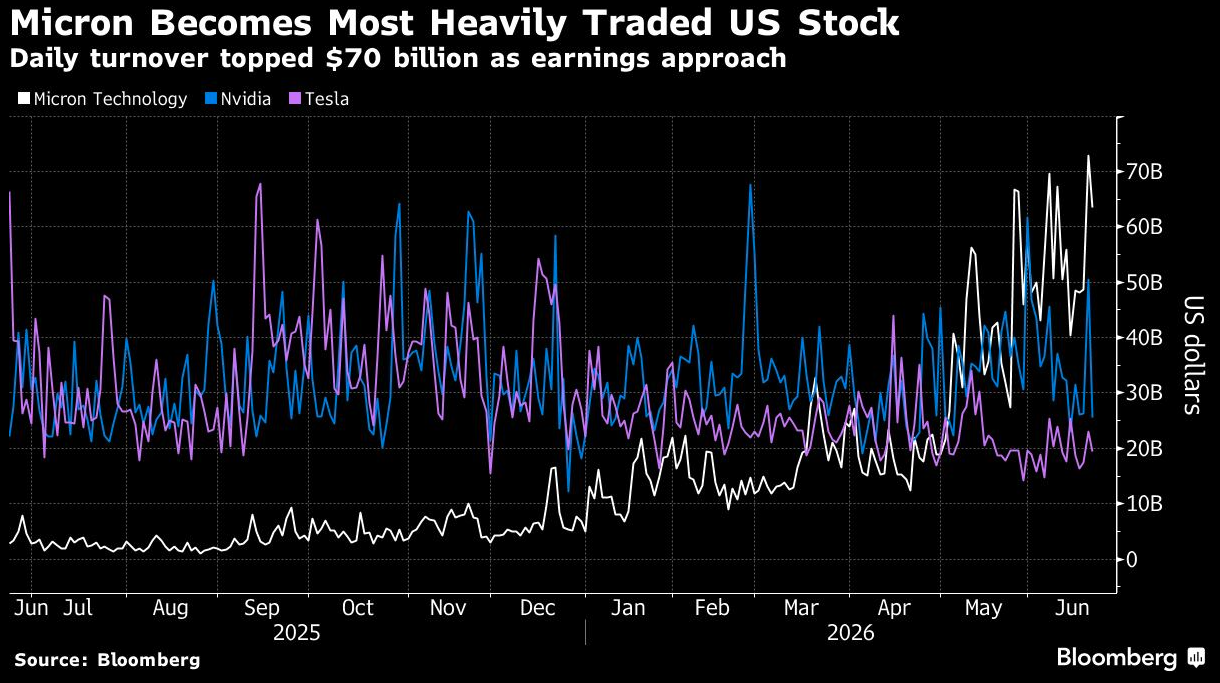
US technology stocks rebounded, lifting key indexes, after the latest flareup of concerns about the scale of the artificial-intelligence-fueled rally wiped nearly $1.3 trillion from the market capitalization of Nasdaq 100 companies over the first two days of the week.
The S&P 500 Index rose 0.4%, steadying from the global tech selloff a day earlier. The Nasdaq 100 climbed 0.5%, while the blue-chip Dow Jones Industrial Average was little changed.
In Asia, stock volatility continued with South Korean equities swinging between gains and losses as investors focused on the outlook for chipmaker earnings. One of that market’s biggest stars, SK Hynix, is looking to raise up to $29.4 billion in a US listing. Results are due later today from Micron Technology Inc., the single biggest contributor to the S&P 500’s 7.8% gain this year.
“You’re going to have these gut check moments,” said Dan Ives, senior equity analyst at Wedbush Securities, in a Bloomberg TV interview on Wednesday morning. “But we continue to view these as opportunities to own the AI winners.”
The ability of two Korean firms to influence US markets is raising concerns about the fragility of a rally that’s been led by chipmakers this year and has fed worries that it has created a stock bubble that’s at risk of bursting.
“It is somewhat alarming to think the US equity market hinges on a market that was up 116% year-to-date and that two companies were responsible for 77% of the market capitalization gain,” said Michael O’Rourke, chief market strategist at JonesTrading Institutional Services LLC.
The next big test for chip stocks arrives after the bell, when Micron reports earnings after the bell. Daily turnover in the stock has topped $70 billion ahead of the report.

Much of Wall Street remains bullish on the outlook for stocks this year. JPMorgan Chase & Co. strategists raised their view for the S&P 500 this year, now expecting the benchmark to end the year at 7,800 points, up from a previous target of 7,600.
Against a backdrop of earnings growth and peace talks between the US and Iran that are pulling down oil prices, “we are approaching our ‘Blue Sky’ scenario,” the banks strategists led by Dubravko Lakos-Bujas wrote in a note.
Crude oil prices are slipping as more tankers are crossing the Strait of Hormuz, with West Texas Intermediate prices falling below $71 a barrel. US oil storage levels will be published at 10:30 a.m. in New York.
Traders also parsed a larger-than-expected US current account deficit for the first quarter. Mortgage applications climbed while building permits slipped month over month. Personal income data and a PCE reading are due Thursday.
This week’s declines are typical of short-term hiccups, said Jennifer Bender, global chief investment strategist at State Street Investment Management.
“We expect these kinds of volatility episodes to continue,” Bender said. “The shifting geopolitical landscape means that political news is less predictable, the world order is increasingly competitive and power-based, and equity markets are more highly concentrated.”
Goldman Sachs Group Inc. partner Bobby Molavi said the current market was beginning to feel similar to the final months of the dot-com era, when investors got used to taking sudden 5% moves in stride. This raises the question of “what happens if 10% breaks, and whether there is no floor in sight after that,” he said.
Among single-stock movers, FedEx shares are falling after the company offered its first earnings report since spinning off its freight division but said inflation and trade turmoil would provide a challenge.
Wendy’s shares soared on Wednesday as stock climbed the ranks in Stocktwits and Reddit’s widely-followed Wallstreetbets forum.
A message from Advisor Perspectives and VettaFi: Discover something new! Click here to register for our upcoming webcasts.
Bloomberg News provided this article. For more articles like this please visit
bloomberg.com.
Read more articles by Geoffrey Morgan, Sagarika Jaisinghani