AI Backlash Is the Risk Wall Street Fears Can Stop Tech Stocks
Market professionals already on edge about the staying power of soaring artificial intelligence stocks are starting to grapple with another risk: public anger toward the technology.
Rising electricity bills across the US are sparking outrage. Data center projects are facing pushback from state and local governments. And workers are fearful that powerful new AI tools will take their jobs.
Any constraints on the data center buildout or taxes aimed at AI could spell trouble for the S&P 500, whose rally is increasingly being fueled by companies benefiting from the flow of money into computing infrastructure.
“There’s a rising populist backlash that’s going to carry forward over the coming years,” said Matt Gertken, head geopolitical strategist at BCA Research. “Investors on a multi-year time frame need to monitor the coalescing of forces.”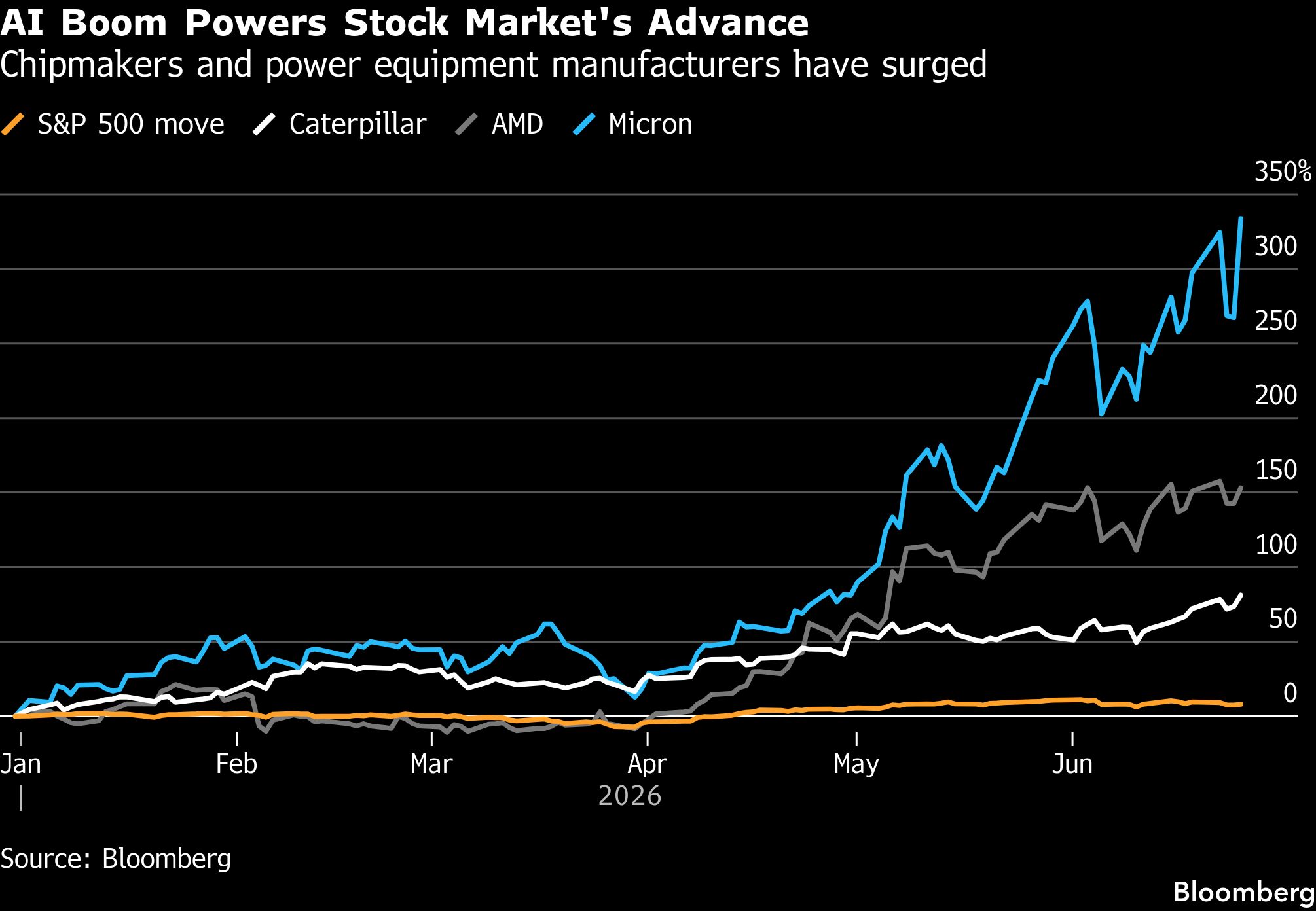
The buildout of AI computing capacity has been a driving force for US stocks for years, but it’s become even more important recently. Memory and storage companies like Micron Technology Inc. and Western Digital Inc. have seen their shares more than quadruple this year amid soaring demand from data center developers. Just eight stocks tied to AI infrastructure accounted for nearly two-thirds of the 7.5% advance that the S&P 500 had notched this year through Wednesday’s close, including construction equipment maker Caterpillar Inc., which also sells power-generation systems.
Semiconductor-related stocks in particular have risen so far, so fast that there’s rising anxiety about the sustainability of the rally. The Philadelphia Stock Exchange Semiconductor Index, which as of Thursday morning was around 93% in 2026 and on pace for its best year since 1999, tumbled 7.9% on Tuesday following a report out of South Korea that Micron rival SK Hynix is slowing expansion of AI memory chip production.
Micron eased concerns late on Wednesday about the outlook for AI demand after its quarterly sales forecast far surpassed Wall Street’s estimates, sending its shares soaring along with those of other chipmakers.
Still, the push back against AI threatens to add another wrinkle to the debate. Just this week, Virginia lawmakers passed a budget that included a tax on data center electricity consumption. The computing hubs have drawn criticism in the state — the world’s biggest market for them — where they’re being blamed for climbing electricity prices.
Local governments from California to Georgia have paused construction of new data centers, and a statewide freeze reached the desk of Maine Governor Janet Mills, who vetoed it in April. Earlier this month, lawmakers in New York advanced a one-year moratorium on large new data centers to Governor Kathy Hochul.
At the national level, progressive politicians have called for versions of both an AI tax and a moratorium on the data-center buildout.
A nationwide data-center ban would be “the worst-case scenario,” said Melissa Brown, managing director of investment decision research at SimCorp. It would deal a sharp blow to markets in the short term, she said, although she expects companies would still find a way to move forward with AI development.
“We’re already in a pretty uncertain political situation, where things can change quickly,” Brown said. “It is hard to tell whether anti-AI sentiment could really take hold.”
When it comes to utilities, power providers may take their cues from the state level, where 36 gubernatorial races are underway, said Tim Winter, portfolio manager of the Gabelli Utilities Fund. Concerns about high electricity bills are already rippling across the sector with Pennsylvania utilities selling off in April after Jefferies warned clients about hostility toward rate hikes.
Fast-Moving Debate
Of course, officials and residents in many parts of the country still welcome data center projects and the jobs and investments they bring. And the Trump administration has largely been a cheerleader for AI development while taking a hands off approach to regulation, although its move this month to restrict access to certain Anthropic models was a notable exception.
“The day we reign in American innovation, we probably stop being the global superpower,” said Michael Monaghan, a portfolio manager at Founder Funds. “As much saber-rattling as there is, I think that in the end, in general, the federal government will stand out of the way.”
Job losses could also drive support for taxes on Big Tech companies in the US, as could a recession that people blame on the technology, BCA’s Gertken said. He sees a chance that the AI rally collapses in 2028, with typical election-year uncertainty heightened by concerns that Democrats will win power and pass sweeping new taxes.
While levies would dent corporate profits, discussion is also growing about other policy or legal issues, Evercore ISI strategists wrote in a note to clients on June 1. The government may implement mandatory reviews of new models, or courts could open model developers up to new liability for the content their systems produce.
“What is particularly notable about this debate is how fast it is moving,” strategists led by Sarah Bianchi said. “If anti-AI fervor continues to build in the country, politicians will increasingly feel compelled to respond — and investors will need to continuously evaluate the policy risks to the AI-centric growth that has become critical to markets.”
Tech Chart of the Day
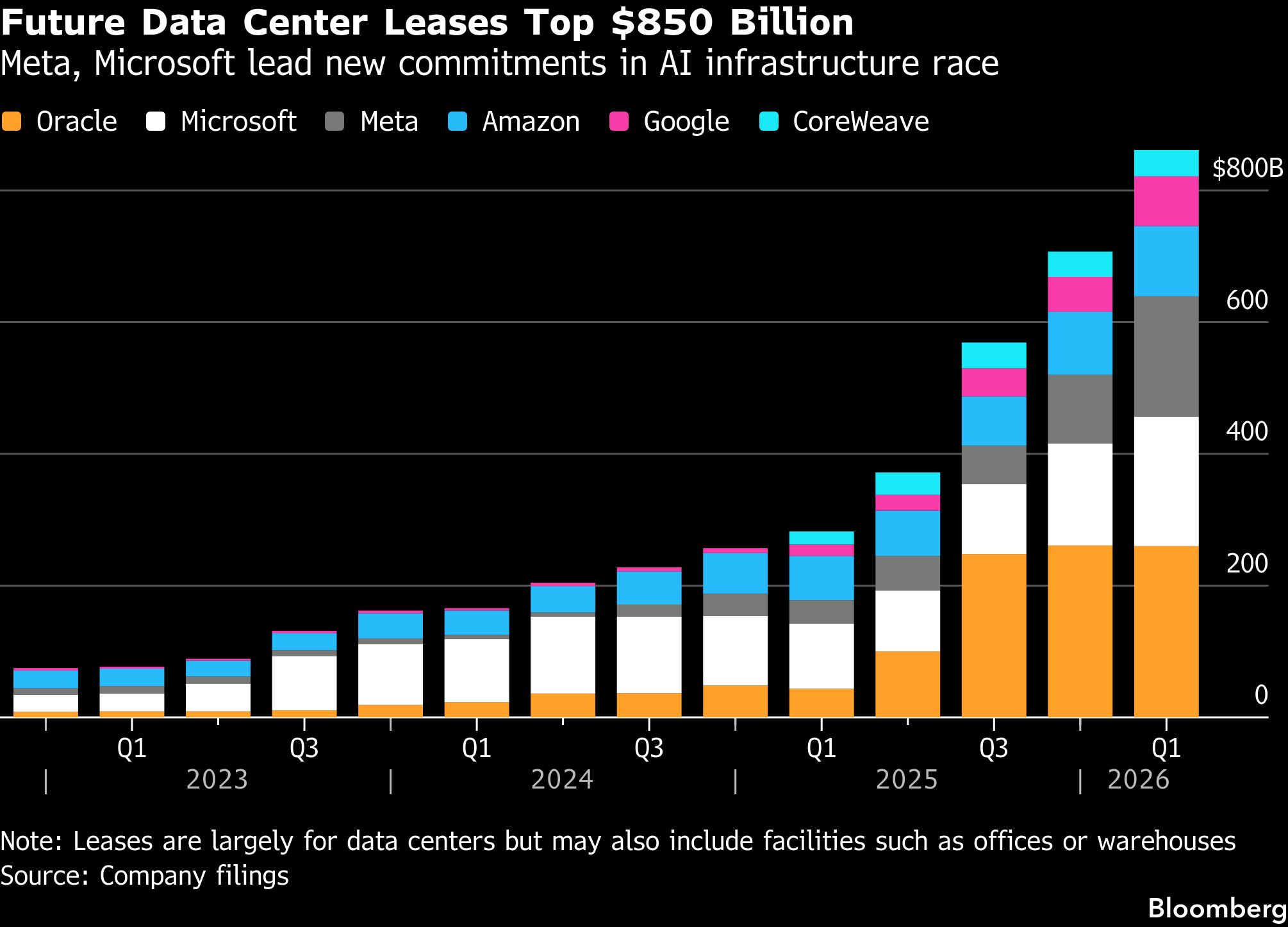
Meta Platforms Inc. and Microsoft Corp. each committed tens of billions of dollars in additional data center leases in their most recent quarters, adding to the massive sums the industry is spending on artificial intelligence.
A message from Advisor Perspectives and VettaFi: Discover something new! Click here to register for our upcoming webcasts.
Bloomberg News provided this article. For more articles like this please visit bloomberg.com.