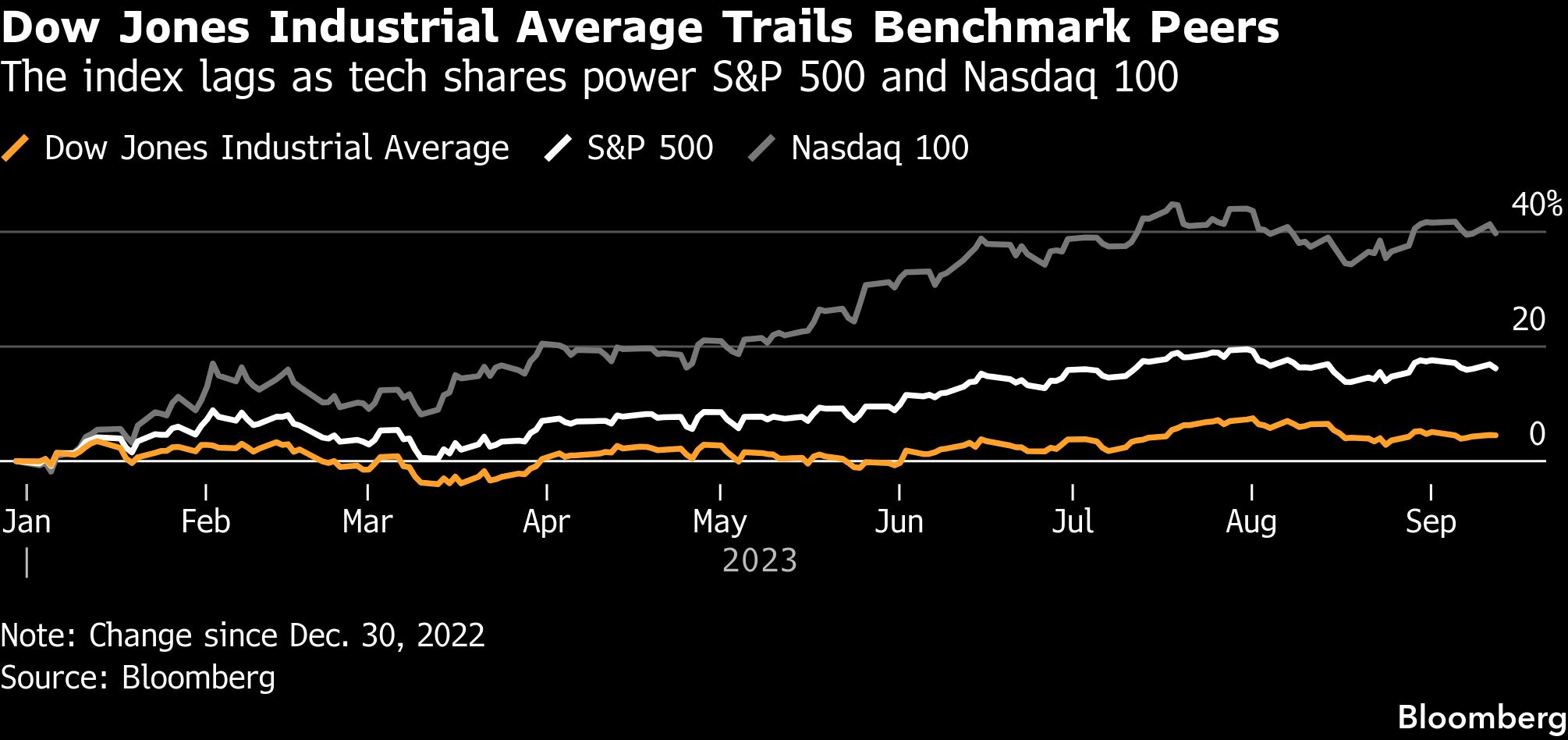
Alphabet Inc.’s addition to the Dow Jones Industrial Average marks another step in the benchmark’s effort to catch up with a market increasingly defined by Big Tech.
The inclusion of the search giant’s parent company, announced Tuesday by S&P Dow Jones Indices, extends a years-long effort to modernize the 30-stock average after criticism that it failed to keep pace with the technology companies driving much of the market’s gains.
Alphabet will replace Verizon Communications Inc. before trading begins June 29, according to a press release from S&P Dow Jones Indices, following the relatively recent additions of Nvidia Corp. and Amazon.com Inc.
“Better late than never,” said Richard Moroney, chief investment officer at Horizon Investment Services and editor of Dow Theory Forecasts. “This move reflects an effort on the part of S&P to make the Dow Industrials more relevant in an era where technology and AI-related stocks dominate the stock market.”
For supporters, the move helps bring the Dow closer to the economy investors actually see today. For critics, it is another reminder that the century-old benchmark often adapts only after the market has already been transformed.
That tension has followed the Dow for years.

Unlike the S&P 500 and Nasdaq 100, which are weighted by market value, the Dow remains a price-weighted index, a structure that historically made it difficult to add high-priced technology stocks because of the outsized influence they would have on the gauge. Stock splits at companies including Amazon and Alphabet helped remove one obstacle to their eventual inclusion.
Alphabet, with its price recently near $346, will be the sixth-largest member in the Dow.
The benchmark S&P 500 gained 16% in 2025, with the tech-heavy Nasdaq 100 climbing 20%. The Dow, for its part, notched a 13% advance.
Alphabet’s inclusion is the latest acknowledgment of that shift. The company has been one of the market’s defining businesses for more than a decade, helping reshape advertising, cloud computing and, more recently, the race to commercialize AI. Its arrival comes years after many investors would have considered it indispensable to any measure of corporate America.
“Adding Alphabet will broaden and strengthen the DJIA’s exposure to these dynamic areas of the US economy,” S&P Dow Jones Indices said in a statement. Verizon, which joined the Dow about two decades ago, accounts for just 0.5% of the price-weighted index because of its relatively low share price. Alphabet’s larger market value and higher stock price, the statement said, make it a more significant communications-services component.
New Generation
The change also highlights how much leadership within the communications industry has changed. Today, the companies commanding the market’s attention are increasingly platform and software businesses whose influence extends across advertising, cloud services, AI and consumer technology.
Alphabet’s stock is up 110% over the past year while a telecommunication services index is off by 14%.
“Certainly it replaces an older generation of tech leader (phone company) with a newer one (internet/AI), but it doesn’t fundamentally fix the measure’s inherent deficiencies,” said Steve Sosnick, chief strategist at Interactive Brokers. “It will also make it harder to escape the gravitational pull of the Magnificent 7, since five of those companies will be among the 30 in INDU.” (Microsoft Corp. and Apple Inc. are in the index as well.)
Whether the latest changes make the Dow more relevant is a separate question.
The index remains one of the most recognized gauges in global finance, but it no longer serves as the primary benchmark for most institutional investors. Assets tracking the S&P 500 and Nasdaq 100 dwarf those tied to the Dow, underscoring how market participants increasingly look elsewhere to measure performance.
Among the more than 5,500 exchange-traded funds in the US, only one use the DJIA as a benchmark — the $43 billion State Street SPDR Dow Jones Industrial Average ETF Trust (ticker DIA), according to data compiled by Bloomberg Intelligence. That compares with roughly $2.8 trillion invested with at least four S&P 500 ETFs and over $580 billion tracking the Nasdaq 100.
“The Dow is more symbolic than something that institutional investors care about,” said Steven DeSanctis of Jefferies. “With that said, that index does need to reflect where both the market and economy are going.”
A spokesperson for the index provider didn’t immediately respond to a request for comment.
The pressure on benchmark providers, meanwhile, extends beyond public-market technology leaders. As private companies stay private longer and reach unprecedented valuations, benchmark operators are increasingly being forced to grapple with how quickly their indexes can reflect the economy they are meant to track. Companies such as OpenAI and Anthropic have become central players in the booming AI industry without giving public investors direct access through traditional benchmarks.
That debate has already begun to surface in index construction. Recently, SPDJI considered — but ultimately declined to adopt — proposals that would have shortened seasoning requirements and eased eligibility hurdles for some large newly public companies entering the S&P 500. Meanwhile, Nasdaq Inc. and FTSE Russell both adopted a rule change that will speed up the addition of these behemoths.
The discussion underscored a growing challenge for benchmark providers: whether rules designed for an earlier era of public markets remain fit for a world where some of the most influential companies spend years outside major indexes.
Alphabet’s addition fits into that broader evolution. For decades, joining the Dow signaled that a company had arrived. Increasingly, the bigger question for index providers is how quickly they can adapt to corporate America as it changes and whether the next generation of market leaders will force them to move faster.
“It seems like the folks at Dow are listening, albeit with a significant lag,” said Christopher Harvey, head of equity strategy at CIBC. “Investors sometimes look at the Dow additions and deletions as contra-indicators or as anecdotal signs that the tech run has gone too far.”
A message from Advisor Perspectives and VettaFi: Discover something new! Click here to register for our upcoming webcasts.
Bloomberg News provided this article. For more articles like this please visit
bloomberg.com.
Read more articles by Issabelle Lee