t used to be a considered something of a tawdry question, although it could be flattering as well: “What’s your number?” Nowadays, your inquisitor is probably asking about retirement — as in, how much you think you need to retire. And, as it often was before, it’s the wrong question.
Is your number $5 million? $1 million? $50,000? No one seems to know how much they’ll need, but whatever they think, they’re probably not on track to save it. That confusion is unsurprising, because a number cannot reveal if you are on track for retirement.
Of course, it’s better to have more money than less. But a “magic number” is meaningless. It is good to have financial goals, and to work toward them, but a wealth goal is counterproductive. The aim shouldn’t be to attain a certain level of wealth by a specific date, but to assure yourself of a steady level of income throughout your retirement. These are fundamentally different objectives, and they require a different investment strategy and mindset from the start.
Magic-number goals tend to be independent from any investment strategy. Do you move into bonds or some other low-risk strategy once you hit your number, to make sure you maintain it? Most people stay in target-date funds, which are invested mostly in stocks even into retirement.
A magic number also does not tell you how much you can spend each month. Maybe you withdraw 4% a year, but without a strategy to hedge against risk, your income will vary each year. Or, if there are several years of bad returns, even your magic number might not be enough.
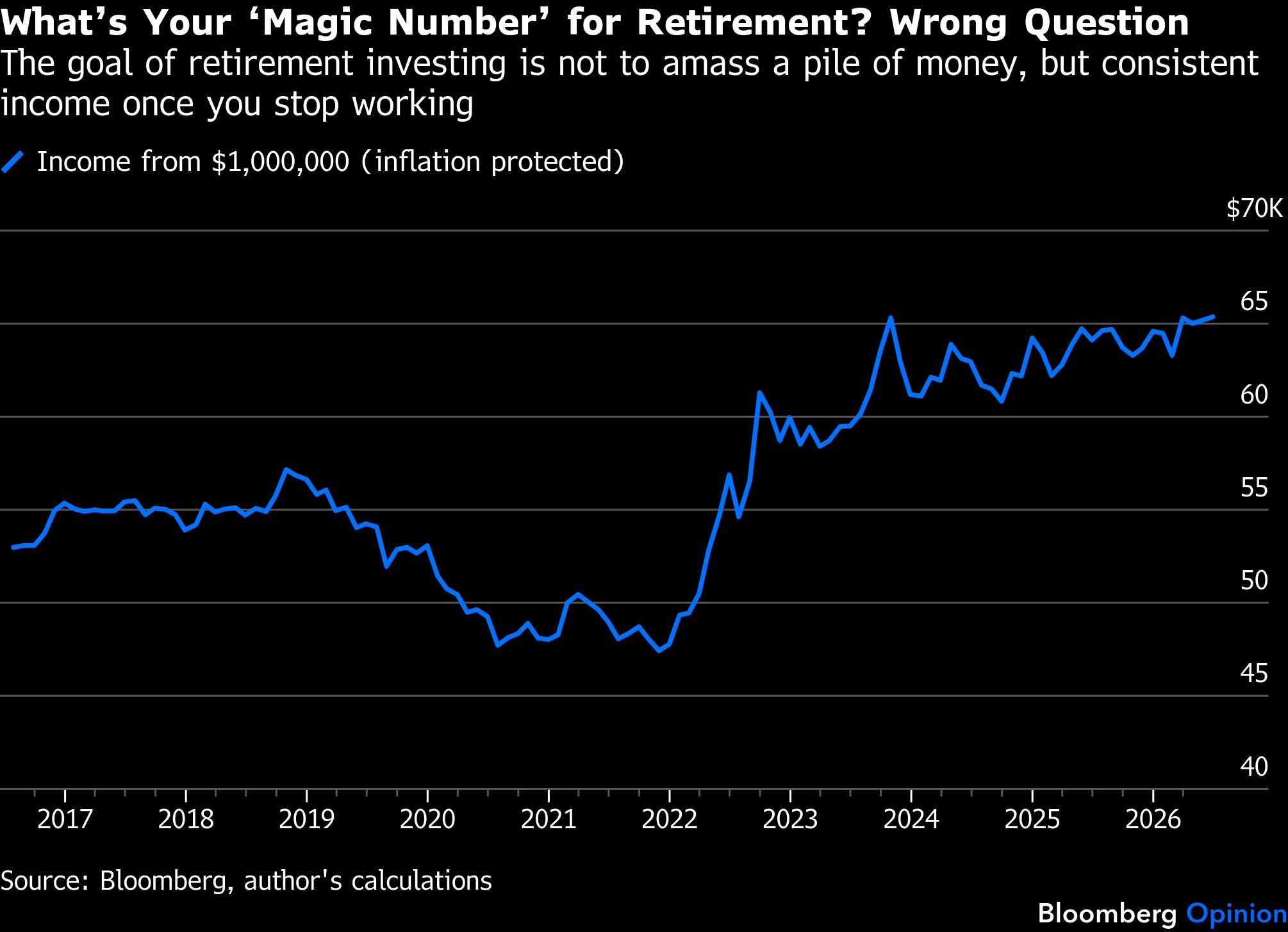
The goal of retirement investing is not to have a pile of money on the day you retire. It is consistent income throughout your retirement. You can achieve this through a number of methods. You can buy an annuity. You can buy lots of long-dated bonds that make regular (inflation-adjusted) payments each year. You can finance your necessary expenses with bonds or an annuity, and take on some extra risk to finance more discretionary spending, like travel.
The point is that all these goals have to do with income, not wealth. Annuity and long-term bond prices also move around a lot, not always in a way that has a predictable correlation with a portfolio of stocks and short-term bonds (which is how most retirement savers are invested). This creates what’s known as a duration mismatch: Your wealth does not provide enough income for you to retire how you want to. If you decide to switch from a wealth to income strategy on a day when the market happens to be up, for example, the prices of bonds could provide you with far less income than you expect.