One of this year’s hottest themes in the stock market has been the crowds of traders chasing the recipients of all the planned spending on new artificial-intelligence data centers.
Now that the hordes who crowded into chipmakers are heading for the exits, some investors and strategists are approaching the theme from a different angle: Focusing on shares of the firms that are helping provide all the funding for the AI buildout. For Ohsung Kwon, an equity strategist at Wells Fargo & Co., the investment cycle makes big banks an “AI-adjacent sector” and that could provide a key reason for further outperformance in their shares.
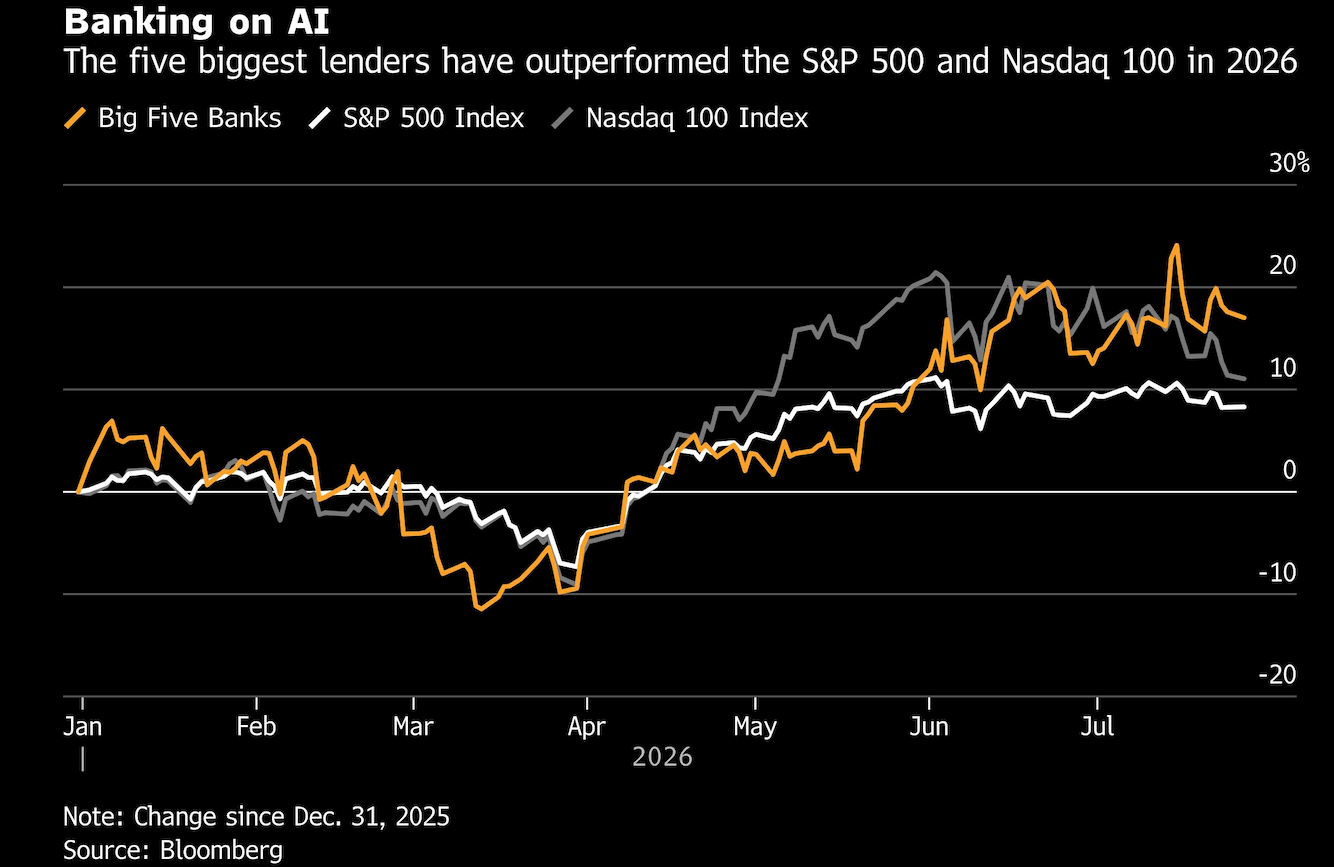
Through Monday’s close, a Bloomberg-compiled index of the biggest lenders — Bank of America Corp., Citigroup Inc., Goldman Sachs Group Inc., JPMorgan Chase & Co. and Morgan Stanley — had risen 14% so far this year. That is more than the S&P 500 and Nasdaq 100 Index, which have climbed 8.3% and 11%, respectively, over the same period. The group has also outperformed both gauges since the most recent market peak on June 2.

The firms stand to benefit from huge upcoming initial public offerings tied to the technology. Kwon believes the market is in the early stages of an IPO upcycle. And on average, banks have outperformed the S&P 500 by eight percentage points during IPO upcycles, according to data compiled by Wells Fargo.
The recent round of second-quarter earnings reports from Wall Street banks highlighted the bull case as they hauled in the most revenue from advising on equity offerings since 2021. That was largely fueled by the record-setting IPO from SpaceX, which allowed Goldman Sachs and Morgan Stanley to collect roughly $100 million of fees each.
Banks are now jostling for work on more big IPOs as AI heavyweights OpenAI and Anthropic PBC wait in the wings to go public.
Large IPOs mean “not just big revenue for investment banking, but also the wealth that was created from IPOs,” said Kwon. “That’s also a tailwind to the banks’ wealth management business as well.”
The benefits to banks go beyond companies going public. As Goldman’s David Solomon explained: The investment cycle for AI means growing capital needs for infrastructure, energy and data centers. Hyperscalers are borrowing tens of billions to fuel their AI ambitions, providing another avenue for banks to benefit.
AI spending is exerting “greater influence” on economic activity and big-bank earnings, according to Doug Peta, chief US investment strategist at BCA Research.
Of course in recent weeks, the AI trade has been rattled amid a return of some of the narratives that drove a selloff earlier this year: stretched valuations, uncertainty surrounding the eventual returns on investment, and ballooning spending plans. That could have a knock-on effect. Bloomberg reported in June that OpenAI was considering holding off on its IPO until next year, which caused shares of Morgan Stanley and Goldman Sachs to fall.
And even if the AI trade does come roaring back, Peta said big banks should not be the “first, or even the second or third, places an investor should look to gain exposure.” That’s because big banks are tied to the broader business cycle more than AI specifically.
“Banks have plenty of indirect exposures to AI spending, capital raising and corporate transactions, but they are not AI-adjacent trades unless nearly every space in the economy has become an AI-adjacent trade,” said Peta.
For now, though, the big banks are seemingly in a good position as both AI and the broader economic backdrop provide support. The KBW Bank Index is up 15% year-to-date. To some market watchers, that outperformance could continue even if the AI trade turns south.
“That’s been helped by a healthy economy, as well as volatile markets and an M&A/IPO boom that have boosted trading income for financial services firms in general,” John Higgins of Capital Economics wrote in a note published on July 17. “If the stock market bubble in AI has already burst — which is plausible even if our baseline scenario is that it won’t until 2027 — then banks are likely to keep outperforming the S&P 500 judging by the dot-com boom and bust.”
A message from Advisor Perspectives and VettaFi: Discover something new! Click here to register for our upcoming webcasts.
Bloomberg News provided this article. For more articles like this please visit
bloomberg.com.
Read more articles by Joel Leon