The global economy continues to recover from pandemic aftershocks, including trade dislocations, outsize monetary and fiscal interventions, a prolonged inflation surge, and bouts of severe financial market volatility. At PIMCO’s 2024 Secular Forum, we explored how the aftereffects of those disruptions are producing some unexpectedly positive developments while introducing longer-term risks.
Jacoby looks at current macroeconomic dynamics through the lens of the movie, “A Bronx Tale,” Robert Di Nero’s directorial debut.
Bitcoin traded lower on May 31, but overall, the fifth month of the year was kind to the digital asset.
While emphasis on domestic bonds is valid, market participants should be careful to not ignore emerging markets bond opportunities.
As the global economy builds on its recovery this year, markets may see increased volatility due to divergent central bank policies, geopolitics and election outcomes.
Avantis Chief Investment Strategist Phil McInnis discusses the firm’s impressive growth and then dives into active ETFs covering small cap value and international equities. VettaFi’s Todd Rosenbluth offers insight into the latest advisor polling data from their recently held Alternatives Symposium.
Intel Corp. Chief Executive Officer Pat Gelsinger took the stage at the Computex show in Taiwan to talk about new products he expects will help turn back the tide of share losses to peers, including AI leader Nvidia Corp.
Fidelity Investments is flexing its muscles in efforts to extract payments from ETF firms in exchange for listing and maintaining their products on its massive platform, stoking industry ire.
As private equity investment in health care has surged to almost $1 trillion over the past decade — funding new technologies, clinical trials and more — a lack of transparency has made it hard to assess whether the industry is also putting patients at risk.
There are many historical relationships within financial markets based on sound economic theory, which accordingly repeat cycle after cycle. High yield bonds and small cap stocks typically move in line with each other, but the two have diverged since 2022.
One of our main contentions in recent months is that the Federal Reserve, by switching from a scarce reserve model to an abundant reserve model, has completely taken over the short-term interest rates marketplace.
The story that captured all media attention last week was Donald Trump’s guilty verdict. But the Trump conviction had no effect on the markets or predicted probabilities in betting markets for him becoming president.
Despite the falling yield spreads, investors continue to bet on rising prices in emerging markets (EM) bonds.
Our outlook on the 11 S&P 500 equity sectors.
Investors’ enthusiasm for artificial intelligence (AI) equities remains undaunted.
Survey after survey has been indicating that Americans feel worse off today compared to the recent past; so much so that many of them indicate the economy is currently in recession, that the rate of unemployment is the highest in several decades, that inflation is very high today, etc.
VettaFi’s Head of Research Todd Rosenbluth discussed the abrdn Bloomberg All Commodity Strategy K-1 Free ETF (BCI) on this week’s “ETF of the Week” podcast with Chuck Jaffe of “Money Life.” The pair talked about several topics regarding the fund to give investors a deeper understanding of the ETF overall.
As the political machinery of an election year roars to life, inundating every media platform with its cacophony, it becomes increasingly challenging to block out the pervasive noise. However, amid this clamor, there are compelling reasons why maintaining focus on your investment strategy is imperative.
Nvidia Corp. and Advanced Micro Devices Inc.’s chiefs showcased new generations of the chips powering the global boom in AI development, deepening a rivalry that may decide the direction of artificial intelligence design and adoption.
After relentlessly pursuing $100-a-barrel oil, the OPEC+ cartel has all but thrown in the towel. Whether the U-turn is a tactical retreat, or a strategic shift, is still unclear. But for now its impact would be the same: Oil prices would be somewhat lower and global inflation would ease.
Emerging markets can offer traders the ability to play off strength outside U.S. borders, and with leveraged ETFs.
As measured by the Russell 2000 Index, small-caps have offered barely any upside this year.
The people who experience the US economy continue to disagree with the people who measure it, and the most likely reason is inflation: Most Americans still see it as a major problem, while most economists don’t. But this debate recently veered from economics to semantics.
AI and EVs can potentially increase the nation’s productivity growth, which would go a long way toward boosting economic growth. However, with the potential benefits come significant investments. Some companies have already made massive investments in those industries. Others, like those involving the power grid, are just getting started.
Corporate greed is not causing inflation, despite the claims of many on the political left who failed to understand the very basics of economic supply and demand.
Data is important but not everything. Perceptions matter, too. Today we’ll look at how people feel inflation and what it may mean in the years to come.
To help put things in perspective, ChatGPT currently has over 180 million users, but there are around 5.3 billion internet users around the world. Imagine if each of them became a regular user of energy-intensive ChatGPT, whose servers are located in the U.S., according to owner OpenAI.
While the money and bond markets continue their Fed-watch saga, there is one constant that we have been emphasizing for the fixed income landscape: a new rate regime.
Market inefficiencies create opportunities for active managers. We believe there are more mispriced companies in small cap growth than in other equity markets, and we have developed an approach that allows us to capitalize consistently when we find them.
Few investments pay off as well as time spent pursuing financial history – to paraphrase George Santayana only slightly: study the past in order to prevent it from picking your pockets.
From potentially brand-damaging ethical risks to regulatory uncertainty, AI poses challenges for investors. But there is a path forward.
Nvidia Corp.’s Jensen Huang will lead a gathering of tech business leaders in Taipei starting Sunday, an unusual opportunity for the industry’s most important executives to come together and figure out the future of computing and AI.
David Dali, Head of Portfolio Strategy, provides his 12-month outlook for global equity markets.
Today’s value stocks offer a magnificent mix of quality, forward-looking profitable firms.
As calls for diversification get louder, it’s a good time to look at healthcare, where long-term bullish trends meet near-term opportunities.
Andy Rothman says China’s moves to address key challenges in its housing sector mark a significant shift from its stance of downplaying problems and signal that further positive macro measures may be on the way.
UBS Group AG completed the historic acquisition of its former rival Credit Suisse, marking a new chapter for the Swiss financial sector as the defunct bank has formally ceased to exist.
When people think about the Federal Reserve and interest rates in 2024, one common view is that economic growth and inflation remain too hot to justify rate cuts. Another is that the labor market and inflation continue to cool, and it will soon be time for rate cuts.
If all the tasks that made ancient Greece tick were automated — from churning out chariots to crafting ceramic vases — it wouldn’t transform the place into Singapore.
Three key reasons why investors should consider allocating capital to private credit for substantial and differentiated returns.
One pairing of disruptive technologies that could ascend to an enviable status is artificial intelligence (AI) and blockchain.
Renewable energy ETFs are making a comeback after a dismal showing in the first half of the year, fueled by the rising tide of bullishness over artificial intelligence.
The Federal Open Market Committee is always data-dependent. But the dependency is not always the same. There are times when inflation matters more than the labor market, and times when the situation is reversed. Every regime is unique. There is never a perfect corollary to a previous experience. This time is not different.
Dell Technologies Inc. shares have been acting like market-leader Nvidia Corp. of late, and investors are betting the company will see a similar boost from artificial intelligence.
To a large and under-appreciated extent, the job of the US Federal Reserve entails chasing an elusive number: r*, or the neutral short-term interest rate. When the Fed’s target rate is above r*, it should restrict growth. When it’s below, it should stimulate economic activity.
Since the Global Financial Crisis of 2007-09, fixed income investors have suffered the worst of both worlds. For a dozen years they endured the stingiest of yields on their fixed income holdings.
The highlight of last week was a showdown between two of the major forces in the markets: AI earnings vs. economic data.
Personalized messaging has a powerful impact. Our Kevin Murphy believes it is time for the financial services industry to deliver personalized solutions and advice.
Last week, the SEC approved the initial regulatory filings for spot ethereum ETFs to trade on various U.S.-based exchanges.
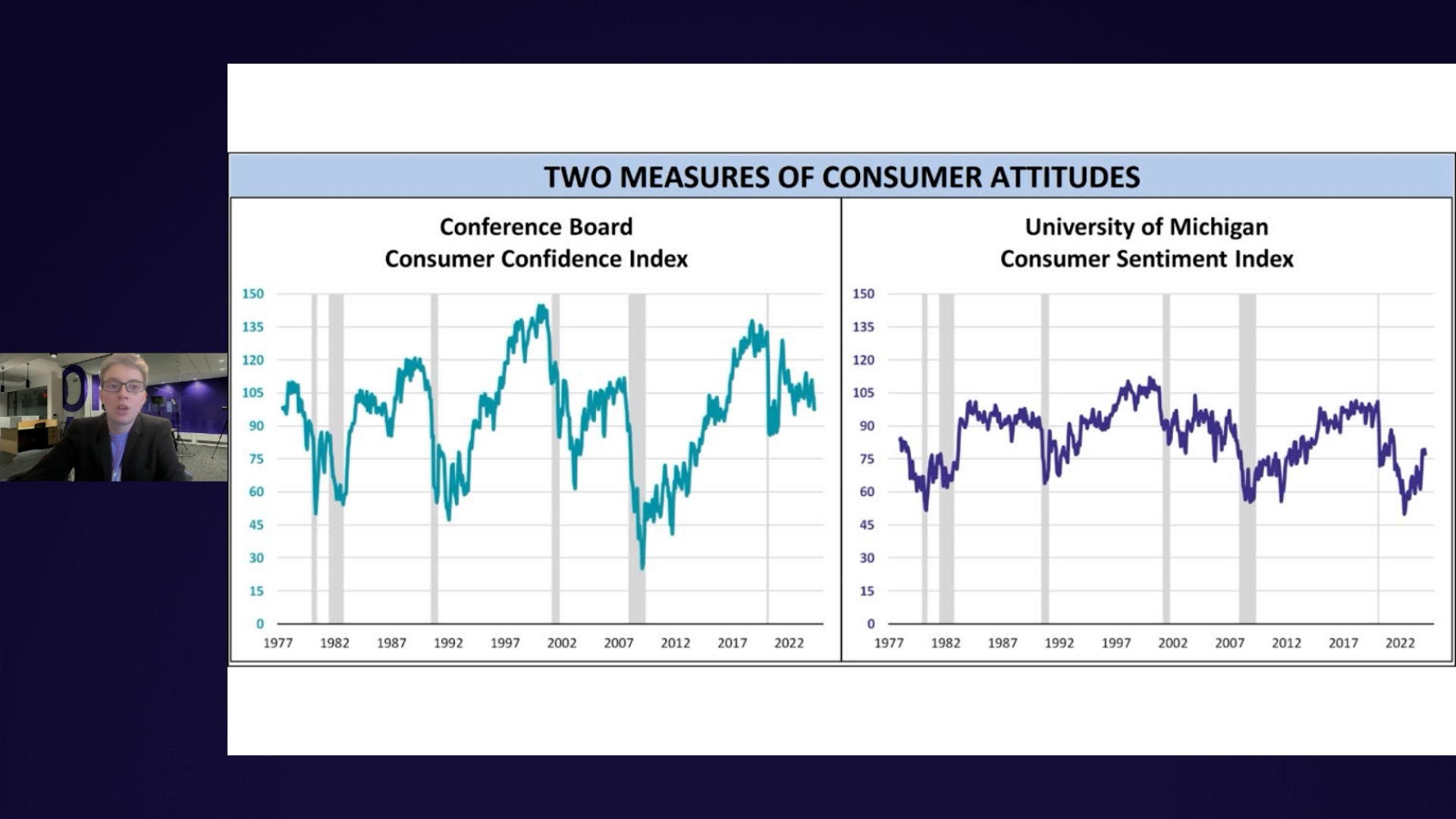
Consumer attitudes are measured by two monthly surveys: the University of Michigan Consumer Sentiment Index (MCSI) and the Conference Board Consumer Confidence Index (CCI). In May, the MCSI fell to its lowest level in six months at 69.1. Meanwhile, the CCI rose for the first time in four months to 102.0.