Video games may be fun to play, but are they also recession proof? Will avid gamers continue to play no matter how bad the economy gets? We explore that question with equity analyst Nathan Meyer, who covers the fast-growing video games industry for Capital Group.
The labor movement is having a moment. In a tight employment market, there is money to be had — or profits to be more generously shared — and workers have gotten some big wins recently. Even reality TV stars and NFL running backs are getting into it.
Expectations of central-bank interventions are helping to steady emerging-market currencies, even as traders adjust to a higher-for-longer regime for developed market interest rates.
This year’s hottest options trade has found its way into the $7.4 trillion ETF arena for the first time, in the latest push by the financial industry to tap booming demand for stock investments with an income stream.
Recently, some clarity emerged on Nvidia (NASDAQ: NVDA) and Taiwan Semiconductor (NYSE: TSM) — two of the most important names in the semiconductor industry.
A wide range of possible outcomes, a multitude of negative earners, and significantly less Wall Street coverage are just a few of the reasons investors in the small-cap universe should consider active managers who could steer them toward better results.
ETFs are the instrument of choice for millions of investors in the U.S. Through a single trade and for a relatively low price, an investor gains broad exposure to a market, sector or niche.
From the dense Amazon jungle to wide stretches of Malaysian palm oil plantations, agricultural practices have been stripping the world of vital forests for decades.
In this first episode, Franklin Templeton Institute’s Tony Davidow discusses the democratization of alternative investments and related topics with CAIA’s John Bowman.
Inflation Update featuring Sam Rines, Managing Director, Corbu LLC
Artificial Intelligence has been a category-killer among investment themes in the past year.
Its impact on the wealth management profession has been profound, from gravity-defying value creation on the stock market to optimizing the day-to-day operations of an advisory practice.
Every participant in financial services, in companies large or small, needs to embrace and integrate this powerful technology into its future, or risk falling behind.
My guest today, Valery Talma, will share his perspective on the state of the art in AI investment management and how advisors can serve their clients better with AI-powered strategies.
VettaFi’s vice chairman Tom Lydon discussed the iShares MSCI USA Quality Factor ETF (QUAL) on this week’s “ETF of the Week” podcast with Chuck Jaffe of “Money Life.”
When I first read about the discovery of a vast new deposit of lithium in a volcanic crater along the Nevada-Oregon border, I can’t say that I was surprised.
This week saw the release of another ode to the genius of Elon Musk, gushingly accepting his pronouncements at face value. Also, Walter Isaacson published a book about him.
A flurry of hedge funds, direct lenders and others are expecting a revival of the $1.3 trillion collateralized loan obligation market — and they want to be ready to reap the benefits when it happens.
Underlying US inflation ran at a faster-than-expected monthly pace in August, leaving the door open for additional interest-rate hikes from the Federal Reserve.
In his latest memo, Howard Marks discusses the essential choice in both investing and sports. Should you go for more winners or try to eliminate losers? That is, should you emphasize aggressiveness or defensiveness? This is a key decision that every investor has to make thoughtfully, and the answer can be different for each person.
ESG has dominated advisors’ minds when it comes to looking at the current generation of young prospective clients. It remains a popular investment approach for millennial and Gen Z clients per surveys.
Known as “onsemi” for short, this Knowledge Leader is a global leader in intelligent power and sensing solutions for industries ranging from automotive to industrial, and from 5G & cloud power to medical solutions.
PIMCO’s Global Advisory Board discusses economic and geopolitical factors shaping the long-term global outlook.
While there are lots of reasons to celebrate the growth stocks inside the NASDAQ 100 index, some advisors might be looking for alternatives to the market-cap weighted index ETFs that reduce their risk profile. Thankfully there are some choices to consider.
Changes in sentiment may drive the performance of the Eurozone equity markets, even with disappointing economic data.
For banks in 2023, one message is coming through clearly: Scale is good.
Tesla Inc.’s Dojo supercomputer may add as much as $500 billion to the company’s market value through faster adoption of robotaxis and network services, according to Morgan Stanley.
Everyone — from moms and pops to corporate treasurers and the mega asset managers — is piling in, won over by a unique opportunity: To lock in a 5% yield, and protect themselves from uncertainty over the US economy.
Why has there been a reluctance within the advisory profession to actively collect, much less leverage client experience feedback?
Growth stocks are getting the better of their value rivals this year. Still, that doesn’t mean exchange traded funds dedicated to value stocks are delivering losses. Rather, the opposite is true. It’s just that growth stocks are delivered better returns though the first eight months of the year.
In September, where volatility can strike at any time, investors will want the safety cushion of bonds for their portfolio. At the same time, short duration continues to be the default play as the U.S. Federal Reserve still attempts to cool down inflation further.
The U.S. dollar has dropped to its lowest level against other currencies in 15 months. In this environment, a wide range of assets stand to profit, not least of which is the AI-infused U.S. technology sector. However, no space stands more ready to benefit from this environment than emerging markets..
Today's economic conditions are attractive for BDCs (business development companies), and some benefit from businesses seeking alternative financing sources.
In the final part of our series on global supply chains, portfolio managers Inbok Song and Sherwood Zhang look at the companies that are reconfiguring their networks and portfolio manager Vivek Tanneeru gives his assessment on the investment opportunities.
VettaFi’s Lara Crigger goes around the world of ETFs, covering recent spot Ethereum ETF filings, short duration bond ETFs, Nasdaq 100 ETF flows, Amplify ETFs’ purchase of ETFMG’s ETF lineup, and the recipe for thematic ETF success. Franklin Templeton’s David Mann discusses the firm’s approach to passive, smart beta, and actively managed ETFs.
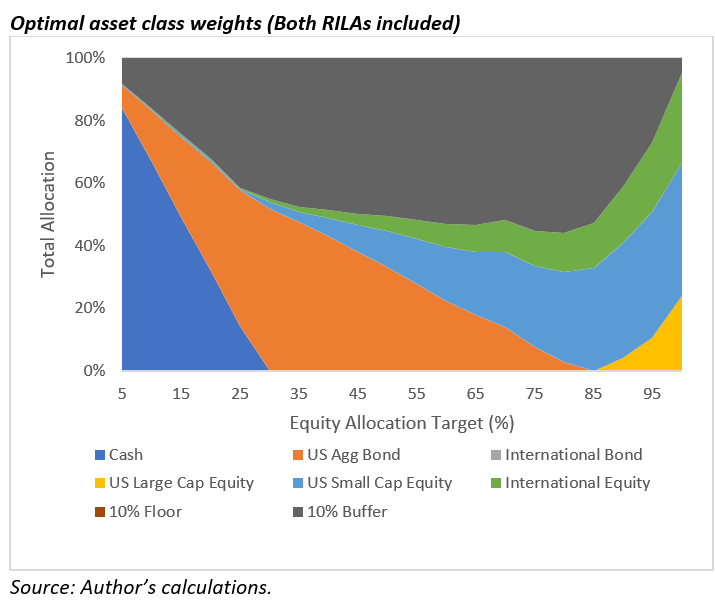
The benefits of RILAs vary significantly by design, and buffer RILAs have historically been a more attractive addition to a portfolio than floor RILAs.
New research shows that stocks have historically been a poor hedge against inflation over anything but very long horizons.
Mega-cap stocks continue to dominate the market in 2023. The question is, why? After all, many other great companies have arguably much better valuations and fundamentals.
All eyes this week will be on the release of the US consumer price index for August on Wednesday, especially after the sharp reduction in inflation from 9.1% in June 2022 to just more than 3% in July.
Morgan Stanley has pushed back against Treasury bears, saying investors should buy US sovereign debt as markets may be too optimistic over the prospect of a soft-landing for the economy.
Traders in the $325 billion industry for emerging-market exchange-traded funds are shifting cash toward strategies that focus on brighter spots in the developing world as China’s economy stumbles.
Innovative provider of custom indexes becomes a key part of a growing suite of VettaFi index solutions, which now power nearly $19 billion in ETFs and other vehicles.
The S&P 500 Index’s surprise 16% rally this year is rewarding traders who bought in early and punishing those who’ve remained skeptical. But fear of a downturn remains.
Even though past performance doesn’t guarantee future results, investors should prepare for continued market volatility this month.
Greetings from Europe. I promised to write a letter describing my personal investment portfolio. I still plan to, but it won’t be this week.
High-yield bonds, often referred to as “junk” or “speculative grade,” are corporate bonds that command a higher interest rate than other bonds. This higher yield is essentially compensation for the increased risk of default that investors assume when purchasing these securities.
An efficient avenue for asset managers and fund issuers to avoid regulatory scrutiny of products with the environmental, social, and governance (ESG) label is to ensure that those funds live up their ESG ETF billing. That can be accomplished with data-intensive approaches.
With government stimulus over, accumulated savings starting to become depleted, rents soaring, and student loans about to switch back on, it appears a credit cycle has begun where borrowers struggle to fulfill their financial commitments.
On the interest rate front, the Federal funds rate is now close to systematic benchmarks that have historically been consistent with prevailing core inflation, nominal GDP growth, and unemployment.
Launches of emerging-market equity funds that exclude China have already reached a record annual high in 2023, as investor concerns grow over weak returns as well as the risks of investing in the nation.
Vanguard has forecasted that inflation will remain sticky, so the U.S. central bank will continue raising rates. But the investment giant also estimates that a recession still won’t hit the U.S. this year.
Conference season has come for Financial Services. Future Proof is coming up and Exchange is right around the corner. Many advisors have complex, busy schedules.
Dina Ting, Franklin Templeton ETFs’ Head of Global Index Portfolio Management, explores the positive trends that are making a case for holding UK equities.