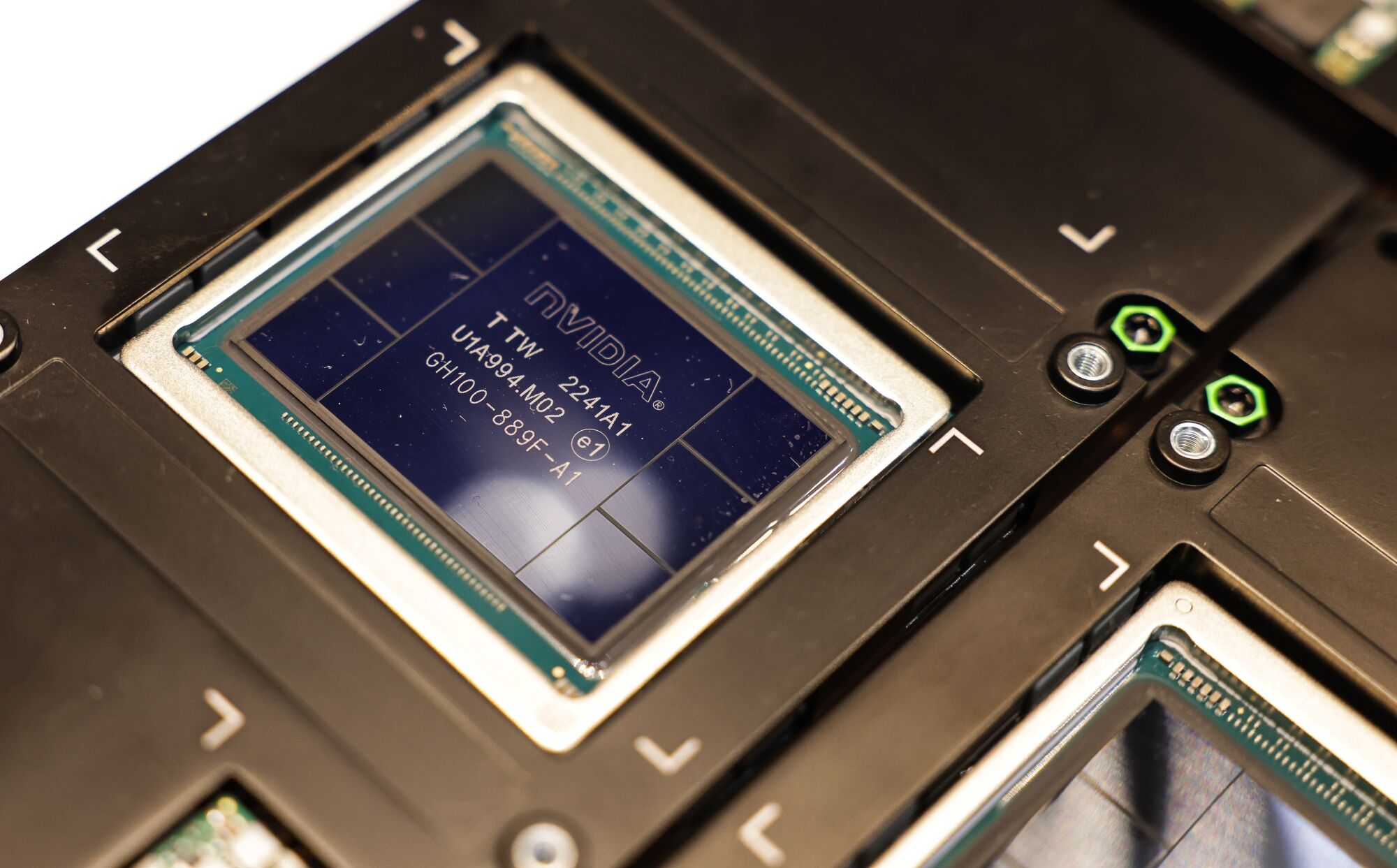
The latest Nvidia Corp. frenzy is fueling an unprecedented rally in the booming industry of leveraged-up ETFs as retail traders go all-in on the world’s “most important stock.”
The US economy expanded at a “slight or modest” pace across most regions since early April and consumers pushed back against higher prices, the Federal Reserve said in its Beige Book survey of regional business contacts.
The semiconductor industry is a strange field. Play your cards right, and you can turn $60 billion or so of annual revenue into a $2.62 trillion business. Do things differently, and roughly the same volume of sales might translate into $44 billion of market capitalization.
High-net-worth investors and family offices are increasingly interested in alternatives, including tokenized assets. As this interest grows, partnering with adaptable jurisdictions is crucial for navigating market uncertainties and leveraging these emerging investment opportunities.
Potential spot ether and spot bitcoin ETFs share some similarities but foundational cryptocurrency differences matter for investors.
Disruptive theme of the week: A confluence of factors have combined to make defense technology a compelling ETF investment theme.
What exactly is a market bubble, and how can investors recognize one?
VettaFi’s Head of Research Todd Rosenbluth discussed the Vanguard Total International Bond ETF (BNDX) on this week’s “ETF of the Week” podcast with Chuck Jaffe of “Money Life.”
Goldman Sachs Group Inc. has put together $21 billion for private credit wagers, its biggest war chest yet for Wall Street’s buzziest asset class.
BlackRock Inc.’s iShares Bitcoin Trust has become the world’s largest fund for the original cryptocurrency, amassing almost $20 billion in total assets since listing in the US at the start of the year.
Risk of a recession is abating as the capital markets could see interest rate cuts this year with signs of cooling inflation.
With the market seeming to skate by the trap door of extreme valuations and unfavorable internals without consequence, the push to new highs in the past few weeks has created the impression of a runaway advance.
The Commodity Futures Trading Commission appears to have little respect for the power of markets, going by their proposal to ban futures contracts on electoral outcomes.
The Alternatives symposium happens on Thursday, May 30 at 11 a.m. ET. The free event will provide CE credits and more to attendees.
The big news in the $20 trillion US property market last week was that, for the first time since the financial crisis, investors suffered losses on top-rated bonds backed by the mortgage on an office building.
The "Rule of 150," or Dunbar’s Number, popularized by British anthropologist Robin Dunbar, suggests that individuals can effectively maintain only about 150 stable relationships. Applying this principle to financial advising can help advisors manage their client networks more efficiently.
We are free trade enthusiasts, in economic terms, even at a time when free trade has been losing some of its aura within the U.S. political system.
You might think that having an ADA-compliant website is only about adhering to legal requirements, but it can actually help your firm grow.
The price of oil is hovering around $76 per barrel, 38% off its 5-year high. With so much geopolitical tension, why isn’t it higher?
Bloomberg’s Eric Balchunas and Van Buren Capital’s Scott Johnsson discuss the SEC’s apparent pivot on spot ether ETFs and everything that might come next. VettaFi’s Cinthia Murphy also touches on the spot ether ETF drama and then dives into the world of alternative ETFs.
VettaFi discusses changes in the MLP/midstream investment product landscape.
In a room filled with more than 800 sugar traders, Sally Lyons Wyatt, an executive at consumer researcher Circana, had an important message to deliver: Ozempic is coming for your industry.
Sometimes industries want to be regulated. It’s not that they favor all of the associated restrictions, but that regulation means legitimation. The mere act of passing laws circumscribes some activities as deserving of legal protection.
After an underwhelming start to the year for US electric-vehicle sales, it might seem easy to conclude that the boom times are over. Sales were flat in the first quarter, Ford dramatically scaled back expansion plans and Tesla laid off 10% of its global workforce.
The US stock market is finally as fast as it was about a hundred years ago.
During ripping bull markets, investors often start benchmarking. That is comparing their portfolio’s performance against a major index—most often, the S&P 500 index. While that activity is heavily encouraged by Wall Street and the media, funded by Wall Street, is benchmarking the right for you?
Shares of Nvidia rallied after it unveiled financial guidance that hints at the AI boom still being in its early innings.
I’m fresh off the plane from Las Vegas—and no, I wasn’t hitting the slots, though the city’s Harry Reid International Airport sure hit the jackpot with a record-breaking 57.6 million passengers last year.
When new inventions turn into market frenzies, the contrarian part of me wants to be skeptical. But the optimistic part of me wants it to be true, especially when the idea promises to change life for the better. Reality is usually somewhere in between.
A Silicon Valley startup backed by the US Defense Advanced Research Projects Agency is seeking at least $70 million more from investors in its quest to to develop an ultra-efficient chip for artificial intelligence technology, according to documents reviewed by Bloomberg.
In a market that’s captured the attention of global finance for allegedly making $1 billion for Jane Street Group, many trading firms are employing a relatively simple strategy: short volatility.
European value stocks offer a compelling case for short- and long-term investment opportunities, supported by strong fundamentals, attractive valuations, and favorable market conditions.
To hear the words “Coinbase” and “Supreme Court” in the same breath likely inspires thoughts of the justices jousting over cryptocurrency. But this week’s decision in Coinbase v. Suski is a reminder that even in our clever new era, old principles of contract law often hold sway.
Rather than dive into a vast pool individual bond options, these three ETFs can provide a low-cost and convenient option.
Will Americans return to the office? It may depend on where it is and what it offers.
Nvidia Corp. just gave the green light to traders betting that the rally in artificial intelligence computing stocks — not to mention its own — has room to run.
The consensus outlook among analysts today is that tech innovation will rewrite the global productivity index, with AI (artificial intelligence) and automation expected to bring a new wave of industry efficiencies.
Investors in emerging-market equities haven’t typically paid much attention to the Middle East. It’s time to take a closer look.
Markets remain highly responsive to economic data as concerns around Fed policy and high interest rates dominate the second quarter.
Are you underweighting large cap growth? New research suggests that may be the case, inviting investors to consider options like FDG.
Nvidia Corp., the chipmaker at the center of an artificial intelligence boom, jumped in premarket trading after a bullish sales forecast showed that AI computing spending remains strong.
Modern cars are equipped with heaps of electronic devices, many of which are designed to reduce the frequency and severity of accidents. But there’s a catch: The high cost of repairing these systems may mean the vehicle is written-off, or totaled, following a crash.
One of the best parts of being a young college graduate, and naïve to the grim realities of the working world, is being deluded about how great your career will be. Maybe you’ll found the next Nvidia, or win the Nobel Prize in your field, or start a charity that will make the world a better place.
Some of the biggest names in tech started paying dividends this year. This includes Alphabet (GOOG), Meta Platforms (META), Salesforce (CRM), and Booking Holdings (BKNG).
Andy Acker and Research Analyst Tim McCarty discuss how artificial intelligence has enormous potential to improve healthcare delivery across the globe and point to some practical applications that could benefit patients – and investors – in the near term.
The Northern Trust Economics team shares its outlook for growth, employment, inflation and interest rates in major markets.
How can global equity investors incorporate the impact of tariffs into fundamental analysis of companies?
Interest in active fixed income products has swelled in 2024, as credit spreads narrow and the Federal Reserve holds fast to a “will they, won’t they” game.
Strong Q1 earnings were a bright spot as sticky inflation and dimmed expectations for rate cuts cast some shade on U.S. equity markets. Fundamental Equities investor Carrie King looks beyond the headlines to offer four takeaways from the most recent earnings season.
The Nasdaq-100 Index (NDX) is higher by 11.30% year-to-date. This confirms that large- and mega-cap growth stocks are proving sturdy.