In this article, Russ Koesterich discusses factors behind gold’s impressive performance year to date.
Economists Stephen Miran and Nouriel Roubini are making waves by suggesting in a paper published last week that the Treasury Department has actively engineered easier financial conditions by increasing the issuance of short-term bills and, consequently, reducing the share of longer-term notes and bonds, thereby keeping yields lower than they would otherwise be.
The Federal Reserve kept its policy rate unchanged at the July meeting, but left the door open to rate cuts later this year.
With tech stocks making up a substantial portion of broad market indexes, investors may wonder what will happen when the tech rally ends.
Today’s passive index investing requires active choices, as customization and innovations in index funds have resulted in new considerations for investors and the potential for greater control.
Federal Reserve Chair Jerome Powell signaled central bank officials are on course to cut interest rates in September unless inflation progress stalls, citing risks of further labor-market weakening.
Nvidia Corp.’s wild ride this week is headed for the record books.
In mid-July, VettaFi's webcast asked what advisors were concerned about. “Market valuation” topped the list of choices with 56%.
Predicting a labor-market downturn was never an easy task. But unique post-pandemic dynamics are making it even harder for economists to determine whether a recent uptick in the unemployment rate is signaling trouble ahead.
Demand growth is cooling, but evidence suggests that overall fundamentals are still sound.
Reasonable Treasury debt ratios and more than enough buyers put Treasuries in a much better light than is commonly heard.
Could this be the last Fed meeting before rate cuts begin? With inflation moderating and job growth weakening, the Fed prepared markets for a more eventful meeting in September while not committing to anything just yet.
The dominance of mega cap technology stocks has started to show signs of abating in the first half of the year, but still casts a long shadow over portfolios. Investors looking to diversify away from large-cap growth have compelling value opportunities in quality small-cap, high yielding developed ex-US and under-owned sectors.
Jeff and Ron discuss the state of the economy, inflation, the bond and stock markets, and they outline, in broad terms, their current investments.
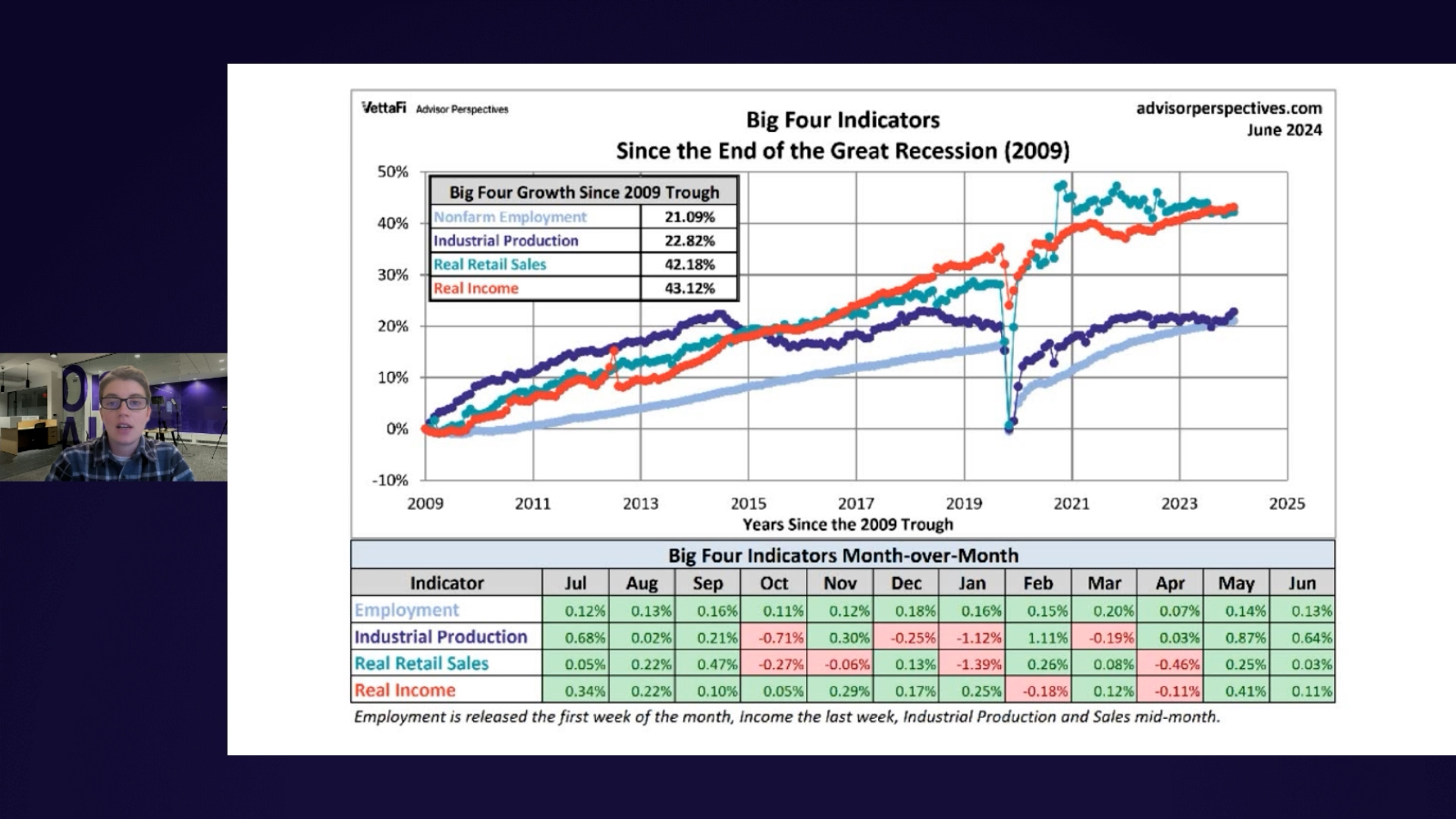
Official recession calls are the responsibility of the NBER Business Cycle Dating Committee, which is understandably vague about the specific indicators on which they base their decisions. This committee statement is about as close as they get to identifying their method.
Third party custodians provide a critical back-office function for RIAs – and beyond the important job of safeguarding client assets, they have more sway over operations than one might initially expect.
It’s hard to work daily with and for someone who clearly doesn’t like you or want you to succeed.
When dealing with millennials and often with more seasoned investors, it’s important to understand their barriers to acceptance of a boring approach to investing.
Investors will want to see valuations justified by robust fundamentals during big tech earnings reports this week.
Options strategies remain a popular choice with advisors and investors for the benefits they bring to portfolios.
US companies added the fewest number of workers since the start of the year and wage growth slowed, consistent with signs of a softer labor demand.
Private equity has been in the news frequently in the last few weeks, and not in a good way.
Which financial assets a central bank should buy and sell is hardly a novel question. Historically, the US Federal Reserve has focused on shorter-term Treasury securities, but quantitative easing had the Fed buying mortgage securities and quality commercial paper in significant quantities. More generally, central banks often hold gold and foreign currencies.
The US Treasury left its quarterly issuance of longer-term debt unchanged for the second straight time, and maintained its guidance that it doesn’t expect to need increasing issuance of notes and bonds for “several quarters.”
Value — defined by stocks with a low book-to-market ratio — handily beat growth by a minimum of 4% on average annually over the period 1927-2014, although surprisingly with a higher standard deviation. In today’s world, think Verizon versus the Magnificent Seven decades forward.
We are approaching a turning point in policy decisions as the FOMC attempts to walk the fine line of hitting their inflation targets while maintaining a healthy labor market.
The economic data is coming in very good for markets. Starting with GDP, we observed a modest growth rate of around 2% in the first half of the year. While not spectacular, it’s far from recessionary conditions. This level of growth, with slight inventory accumulation, suggests a stable economic backdrop.
I chaired an international economics conference in Canada earlier this month. Delegates from all over the world attended to discuss the issues of the day. Following is an abridged version of the meeting summary that I offered during the closing session.
Overly optimistic investor expectations of market returns may be a problem.
Potential for another trade war fueled by a rise in global protectionist policies has investors revisiting the potential impact on stocks, inflation, and economic growth.
VettaFi’s Todd Rosenbluth offers key takeaways from State Street’s 2024 ETF Impact survey. Grayscale’s John Hoffman discusses the debut of spot ether ETFs and the firm’s competitive positioning in the crypto ETF market. Macquarie’s Brad Klapmeyer spotlights their Focused Large Growth ETF (LRGG).
This article examines both breaches at AT&T, discusses how the data can be used to perpetrate detailed deep fakes, and shares how you can advise your clients and staff to protect your clients’ investments.
The US Department of Labor (DOL) offers eight tips for advisors to use to review target-date funds. Our Mike Dullaghan illustrates how to use the DOL tips in preparation for plan review season.
The rise of LLMs and public availability of generative AI tools has driven a wave of excitement over AI’s potential to transform society, economies, and workflows.
Our outlook on the 11 S&P 500 equity sectors.
As gold prices continue to rise, investors may want to consider gold miners, which are offering incredible value.
Macro drivers mixed with market narratives last week to sustain the volatility cocktail being served in July
History is on the side of stock and bond bulls as Federal Reserve officials kick off a two-day policy meeting.
Canadian entrepreneur Andrew Wilkinson’s early decision to ditch a career as a journalist and teach himself web design has proved lucrative, making him the majority owner of a technology investment firm worth more than $300 million.
Unfortunately, investors have little else to work with given the table scraps of useful data being offered by the tech giants. None of the top companies have yet adequately spelled out the financial performance of AI adoption on their income statements.
You don’t need a fortune to channel your giving through a DAF. These funds are designed for everyday people who want to make charitable donations in a way that offers tax efficiency, flexibility, and choices.
The Federal Reserve (Fed) doesn’t like to spook markets, that is the reason why it has crafted its communication on monetary policy to give indications way in advance and nothing has been pointing to a change of heart that could lead to a surprise move next week.
A lack of clients is not a lead generation problem. It’s a conversion problem.
Improving inflation and growth scenarios should enhance the equities and bond dynamic for multi-asset investors.
Listen to enough politicians and it won’t take long to hear about the lack of “affordable” healthcare, drugs, daycare, and housing. This was going on long before inflation returned after COVID. Everyone wants affordable things.
On this episode of the “ETF of the Week” podcast, VettaFi’s Head of Research Todd Rosenbluth discussed the Grayscale Ethereum Mini Trust (ETH) with Chuck Jaffe of “Money Life.” The pair talked about several topics regarding the fund to give investors a deeper understanding of the ETF overall.
The price of ether fell in the wake of the launch of the spot ether ETFs on Tuesday, July 23. Ether (ETH) declined 7.82% in its first three days of spot ether ETF trading.
Volatility is back — at least a little — heading in to a week filled with central bank interest-rate decisions and quarterly earnings for some of the world’s biggest companies.
Is generative AI worth the money?
Baby boomers need to be concerned about worst cases because the rest of their lives could be ruined by the next crash, and with $70 trillion at risk the stakes are high for them and their heirs. So rather than averages, let’s look at worst cases. That’s what baby boomers need to protect against.