The tricky last yards of closing in on — and then maintaining — the hallowed 2% inflation target that all the major central banks adhere to requires a change of tactics. Over the past two years, a mantra of economic data-dependency has been drummed into us, keeping interest rates higher for longer.
No one enjoys getting dumped. This holds true in finance and investing as much as it does in romantic relationships. When companies are dumped from the major indexes, their managers and shareholders may feel jilted and their stock may flounder post-breakup.
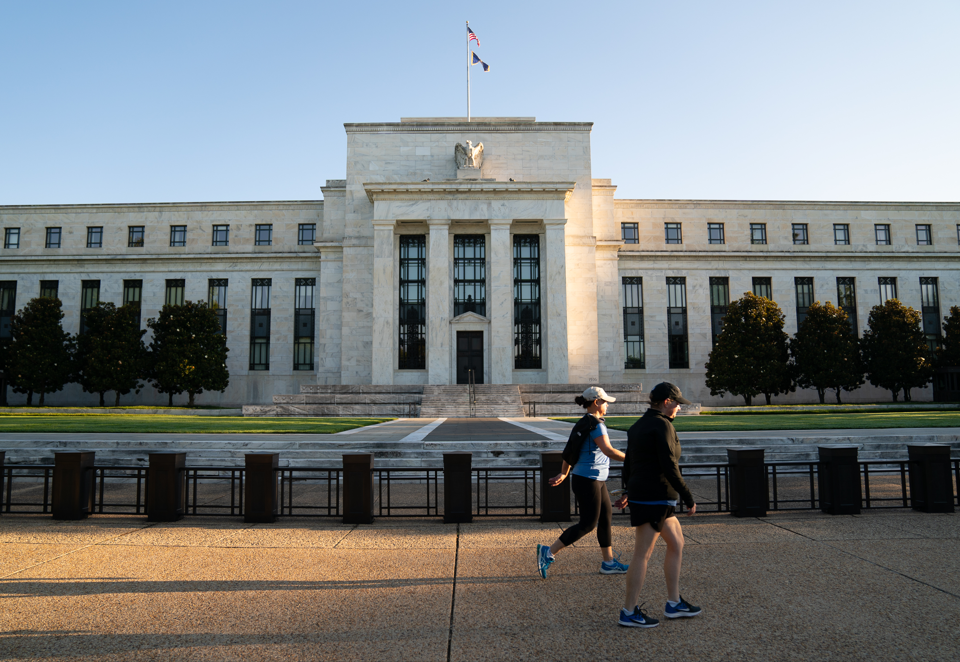
Last Monday morning, I tried to shake up the conversation about how far behind the curve the Federal Reserve (Fed) is currently by suggesting an inter-meeting 75 basis points (bps) cut and another 75 bps cut in September.
The Bank of Japan needs to proceed cautiously.
The acquisition further expands Janus Henderson’s private credit capabilities and complements Janus Henderson’s existing highly successful securitized credit franchise and expertise in public asset-backed securitized markets, and further expands our capabilities into the private markets.
Pretty much every month there’s one week that has the most important economic reports. For the month of August that’s this week. The reports this week include consumer price inflation, producer prices, retail sales, industrial production, housing starts, and unemployment claims.
During volatile times, it is important to maintain perspective, stay focused on your long-term objectives, and avoid knee-jerk reactions based on the latest twists and turns in the market.
On this episode of the “ETF of the Week” podcast, VettaFi’s Head of Research Todd Rosenbluth discussed the ALPS O’Shares US Small-Cap Quality Dividend ETF (OUSM) with Chuck Jaffe of “Money Life.” The pair talked about several topics regarding the fund to give investors a deeper understanding of the ETF overall.
Exaggerated concerns about the viability of Social Security continue to circulate like a persistent urban legend that refuses to die. They have only intensified during the political silly season leading up to the November elections.
Haidt’s The Anxious Generation documents the post-iPhone 4 explosion of anxiety and depression disorders among adolescents. Haidt calls the substitution of screen time for play “The Great Rewiring” of young brains that is directly responsible for the dramatic increase in adolescent mental health disorders.
The statistical and investment views of Nassim Nicholas Taleb, author of the blockbuster book The Black Swan, are easy to summarize. First, most probability distributions are fat-tailed, not thin-tailed like the normal distribution. That renders useless or wrong the application of almost all conventional statistical techniques.
One of the most critical factors explaining the performance differences between small-cap value and large-cap growth stocks is the sector in which the companies operate, and the earnings growth associated with each industry.
The benchmark indexes for emerging-market equities and currencies, respectively, moved in opposite directions Monday, deepening a trend that emerged last week, when their short-term correlation was interrupted for the first time in 21 years.
One of the most widely followed gauges of the stock market, for decades a reliable indicator of future returns, has led investors astray in recent years. Its misdirection comes down to the freakish earnings growth of big technology companies such as Apple Inc. and Alphabet Inc. But there’s a way to revamp this market barometer as worries about elevated expectations and prices grow.
The recent decline in mortgage rates on stronger evidence that the Federal Reserve is poised to ease policy has fueled hopes of better times ahead for companies tied to the housing market. That’s likely true, but the evidence of the past few weeks suggests it’s already too late for a revival this year.
First the private credit firms came for the banking industry’s lucrative corporate loan business. Now they’re grabbing a chunk of their consumer-lending work. The pressing question for this thriving multi-trillion dollar industry is whether it has timed its latest incursion badly.
Slower employment cements the case for the Fed to start a series of rate cuts.
A dizzying start to August, which saw US stocks whiplashed by economic jitters, lackluster earnings and the unwinding of the global yen carry trade, has left Wall Street searching for corners of the market that may have been unfairly punished.
Economic indicators are released every week to provide insight into the overall health and performance of an economy.
I can't let this month pass without noting a significant anniversary: This is the 25th year I’ve been writing Thoughts from the Frontline. You can visit the archive and see every issue since January 2001.
On Monday morning, investors woke up to plunging stock markets as the “Yen Carry Trade” blew up. While media headlines suggested the sell-off was due to fears of a recession, slowing employment growth, or fears over Israel and Iran, such is not the case.
On Monday, global equities and digital assets underwent a dramatic selloff as the unwinding of the Japanese yen carry trade rattled markets. The S&P Global Broad Market Index (BMI), which measures the performance of more than 14,000 stocks around the world, retreated 3.3%, its worst trading day in over two years.
When the Federal Reserve (Fed) cut rates in response to the COVID-19 pandemic, mortgage rates fell below 3% in 2021 and many households refinanced or obtained new loans.
Actively managed ETFs continued to gain traction in July with $24 billion of net inflows. This represented 19% of the industry’s net inflows.
Emerging-market currencies are set to clock their biggest weekly gains of 2024, led by a rise in Brazil’s real on expectations its central bank could raise interest rates later this year.
China’s two-speed economy and the internationalization of the renminbi suggest long-term opportunities may be found amid near-term challenges.
When I was in high school, I really wanted a car. My loving parents took every situation as an opportunity to teach. They told me that if I wanted a car, I would have to earn it.
Investors can still extract yield while adding core bond exposure with the NEOS Enhanced Income Aggregate Bond ETF (BNDI).
It looks like investors have been adding shares of Amazon.com to their carts in recent weeks.
Multi-asset strategies must adapt to a promising—but changeable—environment for generating income.
The Biden administration is nearly finished divvying up $39 billion in grants under the Chips and Science Act, the landmark bipartisan legislation aimed at revitalizing the domestic semiconductor industry. The bigger test still lies ahead.
Municipal bonds maintained their summer strength and posted a second-consecutive month of positive performance in July.
When the Federal Reserve lowers its key short-term interest rate, the impact isn't uniform across the financial universe.
During volatile markets, investors may flock to safe haven sectors like utilities that can weather a recession.
Everybody loves a good comeback story: Seabiscuit. The Mighty Ducks. 493 stocks in the S&P 500 index.
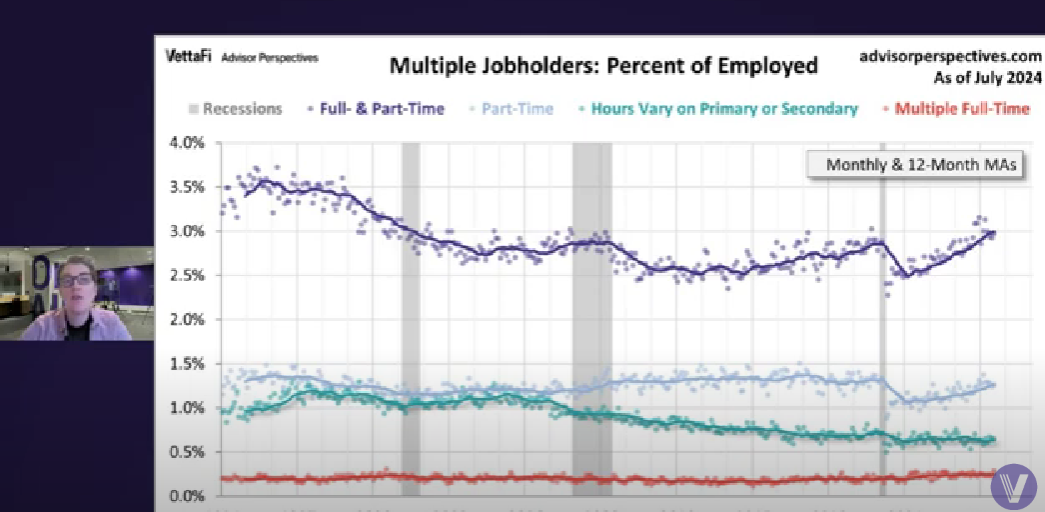
What are the long-term trends for multiple jobholders in the US? The Bureau of Labor Statistics has three decades of historical data to enlighten us on that topic, courtesy of table A-16 in the monthly Current Population Survey of households.
Warren Buffett’s sudden sale of a huge pile of Apple Inc. shares has come with a surprise silver lining for investors in the iPhone maker: Its influence in major stock indexes is set to be fully unleashed.
When markets gyrated at the turn of the month, US and Japanese stocks had the cushion of an earlier surge to fall back on. In Europe, the rout hit share prices that had been weakening since May. An earnings season dominated by pessimism from many of the region’s bosses has vindicated investors’ caution.
A large majority of economists surveyed see only a quarter-point decrease in interest rates coming in September — a finding that’s at odds with calls from some large Wall Street banks for a jumbo cut at the next meeting.
Back in June, a mystery investor made a record wager on long-dated Treasuries, creating waves in the ETF market where trading pros seek clues about sentiment on Wall Street. Now the firm behind that bet has revealed itself, and says its recession call is finally coming to fruition.
The end of the Federal Reserve’s balance-sheet unwind is in sight, though its actual conclusion depends on the pace of interest-rate cuts and stresses in funding markets.
What the Fed's monetary-policy tools signal about the market.
In this PIMCO Perspectives, we explore the dispersion playing out across monetary policy and financial markets.
As the number of Americans retiring in other countries continues to grow, our Bill Cass shares five considerations for individuals planning to retire abroad.
With investors reacting to the worst global stock market sell-off since the early days of the COVID pandemic in 2020, Portfolio Manager Oliver Blackbourn and Global Head of Multi-Asset Adam Hetts consider the all-important question – what next?
The growth of bureaucracy around the world has led to a proliferation of rules. This creates multitudes of problems, one of which is that the state has made understanding what it is doing impenetrable, boring, nuanced, and technical.
Four interlinked principles form a compelling investment philosophy for uncovering promising growth companies.
After absorbing the US Federal Reserve's repeated assurances that a “fundamentally healthy” economy gave it ample time to decide on when to cut interest rates, the market was caught by surprise when new data suggested otherwise. Such is the danger of signaling a consensus where none exists.
The early August sell-off could represent just the market taking a breather after seven months of fantastic returns and could be right back on track, albeit with additional volatility.
A stealth bear market could be defined as a bear market where several stocks have fallen more than 20% within the market, but yet the overall market itself hasn’t fallen. That’s why we call it a stealth bear market.